

How Ennio Morricone gave the world the greatest cinematic music moment of all time
Read More


The soundtrack is so important to Quentin Tarantino that his name can be used to define a music genre. It isn’t a typical genre like country or indie, it’s some swaggering amorphous beast united by an air of pure atmosphere. As he once declared of his own process, “I go through my record collection and just start playing songs, trying to find the personality of the movie, find the spirit of the movie.”
Seen as the king of Indiewood following the release of his debut picture Reservoir Dogs, Tarantino gently toyed with the tropes of cinema and enhanced them with a self-referential style that ensured his audience knew he was a movie fan before becoming a director. It’s a style that has underpinned his work ever since and can also be heard in the soundtracks mentioned.
In truth, it makes perfect sense. The only thing in the world more immediately transformative than music is that imagined extra step at the top of the stairs; everything else comes in waves. No matter how dramatic the onscreen moment, it is the synergised jolt of music and action in unison that stirs up the reticently stored reserves of adrenalised emotional response.
“One of the things I do when I am starting a movie, when I’m writing a movie, or when I have an idea for a film,” Tarantino writes for the liner notes of his soundtrack compilation, “Is I go through my record collection and just start playing songs, trying to find the personality of the movie, find the spirit of the movie. Then, ‘boom,’ eventually I’ll hit one, two or three songs, or one song in particular, ‘Oh, this will be a great opening credit song.’”
With that in mind, is there a more immediately memorable title sequence in movie history than that great Dick Dale bass insanity, ‘Miserlou’, that blasts off Pulp Fiction to a sonic blitzkrieg of excitement? Can you really picture Mélanie Laurent putting lipstick on without hearing David Bowie purr, “See these eyes so green”?
Behind each of these choices is an obvious but highly thought over intent. The anticipation of action is in place before the opening credits have even faded, as Tarantino explains: “Having ‘Miserlou’ as your opening credit is just so intense. It just says, ‘You are watching an epic, you are watching this big old movie just sit back.’ It’s so loud and blearing at you, a gauntlet is thrown down that the movie has to live up to.” He is undeniably right too; the song offers a first impression that is branded on the viewer’s sensibility throughout.
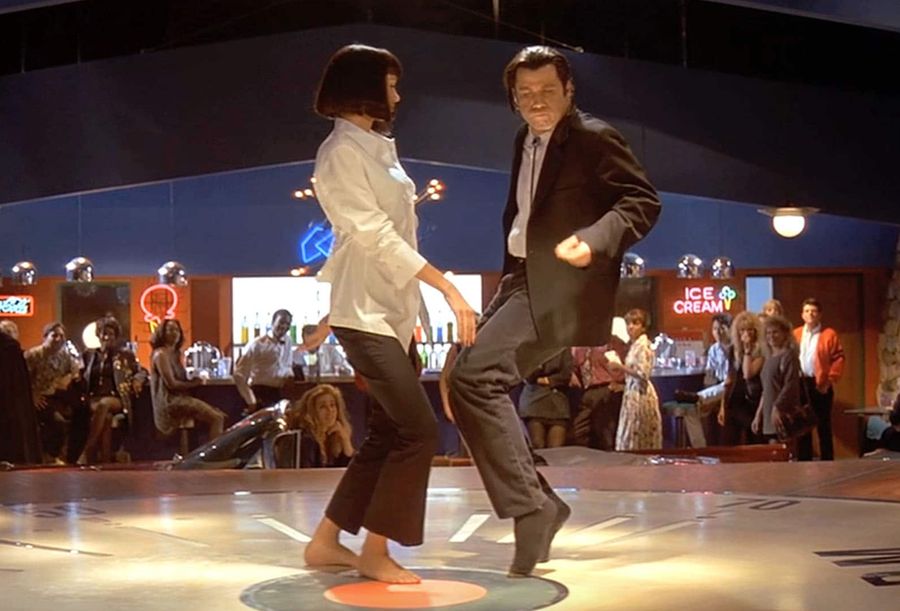
It is a firm introductory handshake that reveals a lot about the person the hand is attached to. Pulp Fiction then goes on to impart many more iconic movie music moments, in twisting dance scenes backed by the perfectly curated ‘You Never Can Tell’ by the rock music luminary Chuck Berry, or the hi-fi sexy tension punctuator ‘Girl You’ll Be a Woman Soon’ by Urge Overkill.
In fact, across all of his films, Tarantino’s use of songs and scores to illustrate, narrate and render his movies is impeccable. These scintillating scores that transport ‘edge-of-your-seat-stuff’ from tired cliché to tangible reality, don’t come without due forethought, “When you do it right and you hit it right then the effect is you can never really hear this song again without thinking about that image from the movie.”
We’ve collated the best of the tracks that provide these magic moments where music and movie collide in a superb playlist below. From the quirky flourishes of Quincy Jones to the booming bravura of Bobby Womack, these are the best jams that Tarantino has brought to us. Enjoy…
All the latest Quentin Tarantino content from the independent voice of culture.
Straight to your inbox.
