


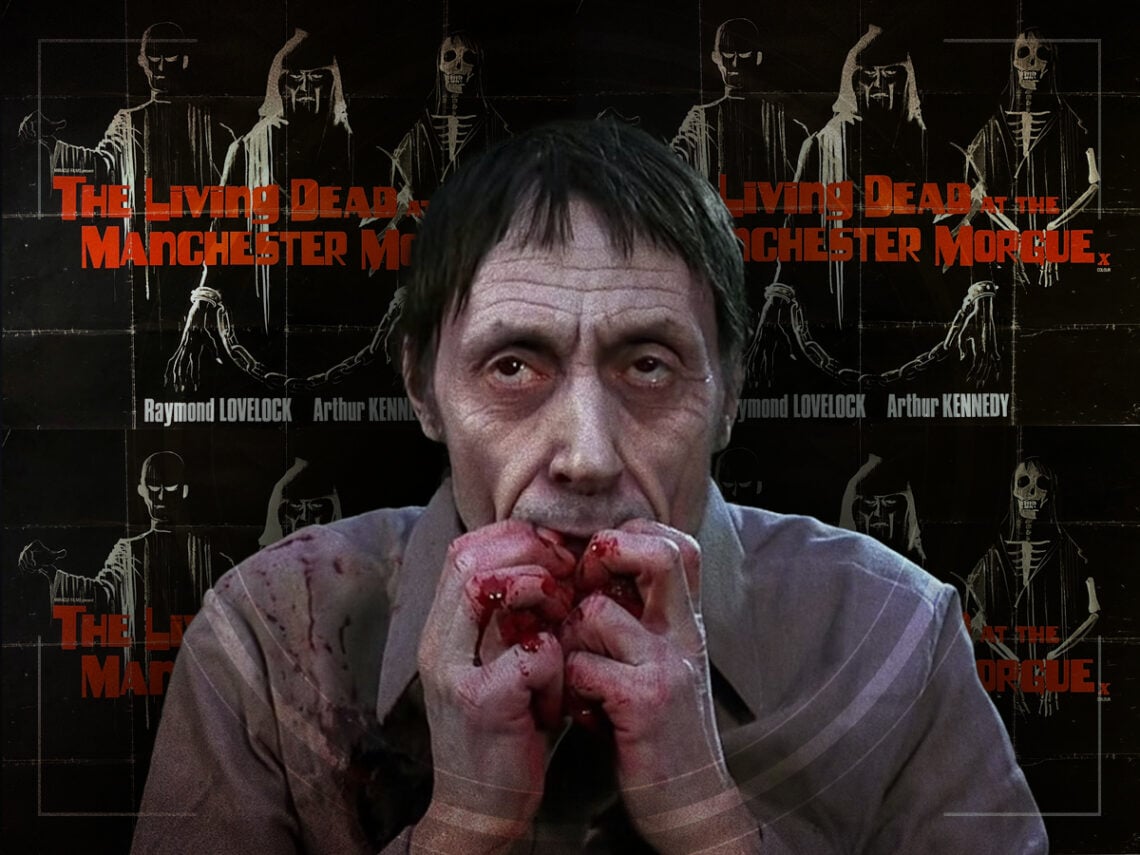
‘The Living Dead at Manchester Morgue’: How a 1970s Spanish horror movie took over the Peak District

The 1960s and ‘70s were a goldmine of low-budget horror movies, many coming from the United Kingdom and other European countries like France, Spain, or Italy. On the surface, many of them look schlocky and perhaps a little camp – and many of them are – but dig a little deeper, and you’ll find some surprisingly scary and transgressive pieces of cinema.
The horror genre blossomed during this era, perhaps due to the easing of film censorship in America and the slight waning of stuffy conservative views, which meant a movie like The Texas Chain Saw Massacre would be practically unimaginable two decades before. Cinema was changing, and as horror grew as a genre, you could find more sleaze, violence, and gore emerging from the minds of filmmakers, even if their budget – and resources – were limited.
Many underrated gems were released during this period of increased horror experimentation that have since become cult favourites for scary movie lovers, but have been forgotten in the mainstream. The Living Dead at Manchester Morgue, otherwise known as Let Sleeping Corpses Lie, is a fantastic example, made particularly interesting by the fact that its quintessentially British setting is hardly rooted in British filmmaking at all.
The movie begins with a man leaving his work in Manchester and driving across the Peak District, we’re given some great shots of the city back in the ‘70s, and once we reach the countryside, these glorious pastoral scenes are instantly familiar to any Brit, with winding roads and stretches of green forming the backdrop to the zombie horror, yet the main character, George, was actually played by the Italian actor Ray Lovelock, his voice dubbed in English by John Steiner.
Meanwhile, his female companion, Edna, is played by the Spanish actor Cristina Galbó, even though she appears to be English, and the rest of the cast is rounded out by Italians, Spaniards, and Americans, despite the fact that we seem to be watching a distinctively British production, as the film was written by Italian screenwriters Sandro Continenza and Marcello Coscia, while the Spanish Jorge Grau was in charge of direction.
As a joint Spanish and Italian production, it seems odd that the movie is specifically set in England, with references to Manchester and the Peak District. We see the pair stop by those recognisable Dovedale stepping stones, where Edna first witnesses the drowned zombie man who subsequently tries to attack her. The village of Southgate in the film is actually Castleton in Derbyshire, a small village that seems like the last place you’d find a Spanish director assembling a crew to make a zombie movie.
Yet, back in the ‘70s, horror movies set in Britain were having their moment, you could say, so maybe that was a factor in Grau and his team opting to set his horror movie in the Peak District. Pastoral settings making way for darker stories could be seen in the likes of popular British horror movies like 1968’s Witchfinder General, 1971’s Blood on Satan’s Claw, and 1973’s The Wicker Man, which marked a distinctive era for the genre, so this undoubtedly played a part in shaping the setting of the film, which came in 1974.
The Living Dead at Manchester Morgue might not deal with folk themes, but its countryside setting is the perfect, quaint and idyllic scene to contrast with the relentless zombies, who terrorise residents after getting infected by a new radiation machine being trialled by the Ministry of Agriculture to kill insects and pests.
While it was long forgotten, the film is actually pretty great, and it’s amusing to imagine this group of European filmmakers deciding on places like Manchester and Castleton to serve as key locations for their scary movie.
