


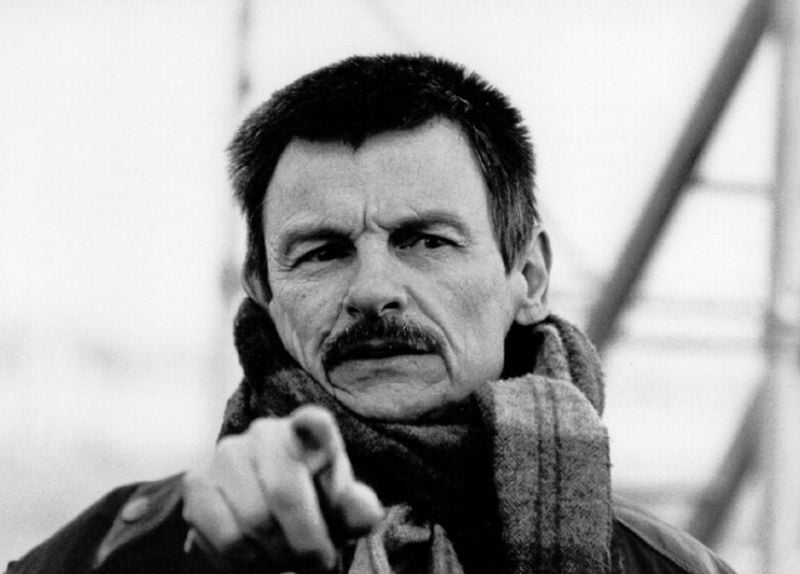
The 16th-century painting that inspired Andrei Tarkovsky

Soviet pioneer Andrei Tarkovsky had a profound impact on the history of cinema, reaching artistic heights that had never been reached before. Known for his flawless filmography, which is full of masterpieces like Andrei Rublev and Stalker, Tarkovsky investigated the deep link between film and time while developing his influential aesthetic principles for the medium. That’s exactly why several generations of filmmakers have tried to follow in his footsteps.
In many interviews, Tarkovsky had openly spoken about his love for directors such as Ingmar Bergman and Robert Bresson, as well as the literary influences that shaped his artistic sensibilities. In addition, he was also inspired by painting and reflected on the philosophical connections between the two mediums in many of his films. However, there is one particular painting that had a profound impact on Tarkovsky and influenced his works.
Titled ‘The Hunters in the Snow’, it’s a 16th-century masterpiece by Pieter Bruegel the Elder, which depicts a group of hunters who are returning to town after a failed outing with their dogs. It’s a stark portrayal of winter that captures a sense of quiet devastation, an undercurrent of misery that’s hiding inside the folds of a silent, idyllic existence. The painting was interestingly referenced in Tarkovsky’s Solaris, functioning as an interface upon which memories are played out in a completely unfamiliar environment of the spaceship.
‘The Hunters in the Snow’ also had an impact on Tarkovsky’s autobiographical 1975 opus Mirror, operating as a philosophical foundation for the aesthetic frameworks used by the director as well as the allegorical trajectories present in the narrative. Although the only deviation from Tarkovsky’s life was the depiction of the narrator as a dying man, that aspect has become the most important part of Mirror since the director succumbed to his illness about a decade later as well.
“All the episodes were really part of our family history,” Tarkovsky said. “All of them, without exception. The only made-up episode is the illness of the narrator, the author (whom we do not see on the screen). By the way, this very interesting episode was necessary in order to convey the author’s spiritual crisis, the state of his soul. Perhaps he is mortally ill, and perhaps this is the reason for the recollections that make up the film — as with a man who remembers the most important moments of his life before he dies.”
One would think: why was such an elaborate reconstruction of the past necessary? Or not even the past but what I remembered and how I remembered it. I didn’t try to search for a particular form for the internal and subjective memories, so to speak; on the contrary — I strived to reproduce everything the way it was, i.e., to literally repeat what was fixed in my memory. And the result turned very strange… It was, for me, a singular experience.”
Bruegel’s ‘The Hunters in the Snow’ remains an important work of art that has been referenced by some of the greatest filmmakers, ranging from Abbas Kiarostami to Lars von Trier and Roy Andersson. In fact, von Trier’s Melancholia probably uses it in the most interesting way – as a pre-apocalyptic image that conveys the magnitude of the unimaginable silence before the end of the world.
Check it out below.
