


15 brilliant LGBTQ+ filmmakers you need to know

For the longest time, artists belonging to the LGBTQ+ have been subjected to marginalisation and there have been active attempts to wipe their identities from their legacies. Despite the historical erasure, scholars as well as those interested continue to discover the beauty of the masterpieces these geniuses have left behind.
One of the greatest contemporary filmmakers, Pedro Almodóvar, once explained: “Homosexuality and homosexuality in films is understood very different here than it is understood in Spain. In Spain we don’t differentiate movies with homosexuals from movies without. In Spain there isn’t really a gay community. Here things are much more divided. In my films homosexuals are part of the film but no more. There is not a political posture or position on their part or on my part.”
He added, “I am only talking about characters that are alive and who form a part of my films in the same way that they form a part of society. And I think that creates some sort of confusion here. For example, I can understand the difference between an independent film and big-budget studio film, but I will never understand how there are gay films. I think that that is a form of classification that has nothing to do with a film. That is the way in which we understand things, even though here it is understood differently. And that sort places me in a no man’s land, because I am not a gay director.”
In celebration of Pride Month, we take a look at 15 filmmakers from the LGBTQ+ community whose works have deeply moved and inspired millions of people around the world.
15 brilliant LGBTQ+ filmmakers you should know:
Dorothy Arzner
Dorothy Arzner’s filmmaking career started during the silent era and lasted for almost two decades during which she produced multiple seminal films like Dance, Girl, Dance and Merrily We Go to Hell. Although she was almost forgotten until the ’70s, her work has championed by feminist critics for their explorations of female relationships, sexuality and gender.
Arzner recalled, “I had been around the theatre and actors all my life. My father, Louis Arzner, owned a famous Hollywood restaurant next to a theatre. I saw most of the fine plays that came there—with Maude Adams, Sarah Bernhardt, David Warfield, et cetera, et cetera, ad infinitum, D. W. Griffith, Mary Pickford, Douglas Fairbanks, Mack Sennett, and all of the early movie and stage actors came to my dad’s restaurant for dinner. I had no personal interest in actors because they were too familiar to me.”
Jean Cocteau
French literary intellectual and filmmaker Jean Cocteau was a true pioneer whose experiments with the cinematic medium had a formative influence on the French New Wave. His films as well as his writings employ homoerotic symbolism in their attempts to uncover the reality of the human condition.
Cocteau once wrote, “As far back as I can remember, and even at an age when the mind does not yet influence the senses, I find traces of my love of boys. I have always loved the strong sex that I find legitimate to call the fair sex. My misfortunes came from a society that condemns the rare as a crime and forces us to reform our inclinations.”
Pier Paolo Pasolini
Italian filmmaker Pier Paolo Pasolini was openly gay from the beginning of his creative journey but his works were concerned with other aspects of sexuality. Most famously in his 1975 masterpiece Salò, Pasolini uses homosexuality and sodomy to convey an incomparable sense of violation and existential despair.
“What is it that urges me to create. As far as film is concerned, there is no difference between film and literature and poetry—there is this same feeling that I have never gone into deeply,” Pasolini reflected. “I began to write poetry when I was seven years old, and what it was that made me write poetry at the age of seven I have never understood. Perhaps it was the urge to express oneself and the urge to bear witness of the world and to partake in or to create an action in which we are involved, to engage oneself in that act.”
Lino Brocka
One of the most influential Filipino filmmakers of all time, Lino Brocka was regarded as a controversial figure during a volatile political regime for his ability to speak truth to power. He was a founder of the Concerned Artists of the Philippines which tried to initiate honest conversations about problems plaguing the country.
In an interview, Brocka said, “I’m very open because I am a movie-goer. I love films, I love those violent, action-packed Hong Kong films, the way they are edited, the way the action scenes are choreographed, they are just fantastic. But in my case, in my country, it pains me that we import about 500 foreign films and we make about 150 local films and they’re complaining about the one film I made!”
Chantal Akerman
Belgian filmmaker Chantal Akerman is regarded by many critics as one of the pioneers of feminist cinema. Through her work, Akerman conducts examinations of modern feminism by comparing the female condition to the monotony of domesticity.
“I don’t feel I belong anywhere. On the contrary, I have the feeling that I am only attached to the land under my feet. And even there the ground is often a bit shaky,” Chantal revealed. She did not like the labels of “Jewish” or “lesbian” and considered cinema to be a “generative field of freedom from the boundaries of identity.”
John Waters
John Waters is often considered to be the Sultan of Sleaze and rightly so. Always transgressive and bold, Waters assaults our pre-conceived notions of civility and culture with his blatant disregard for what society considers to be appropriate. He has produced true cult classics like Pink Flamingos which have not to lose any of their disgusting magic even after all these years.
The director commented, “I think that after Trump, nothing is so good it’s bad. He’s ruined the word ‘bad’. There’s nothing that’s ‘good bad taste’, it’s all just ‘bad bad taste’. It’s almost not worth being remarked on. I think it’s hard for anything to be so bad it’s good anymore.
“My films were made knowing what they were, and audiences came to see them without any irony, unlike with many cult movies that were made seriously and were so bad that they’re funny today. My movies are made so that, I think, you’re laughing with them rather than laughing at them. Even if you hate them!”
Derek Jarman
Experimental filmmaker Derek Jarman’s artistic explorations of homosexuality and masculinity will always be considered to be indispensable parts of the history of cinema. An advocate of gay rights, Jarman used the cinematic medium to respond to social injustices and historical oppression.
While talking about his magnum opus [Blue], Jarman explained: “I wanted to convey some of what I’d seen, and the disaster of which I’ve been living through of the last few years. I mean for instance, last Thursday, I was in the hospital, and there was a mom with a two-year-old child who’s got the same infection in the eyes as I have, I couldn’t…
“I sat and watched as I waited, it was just quite terrible, honestly, you know, I was thinking of this child, you know, that’s all happening and people don’t see it, and they don’t think about it very often, and I hope the film sort of makes people think about that just for a moment.”
Todd Haynes
One of the pioneers of American Eccentric Cinema, Todd Haynes has established himself as a master of transgressive cinema. From his explorations of queer culture in Poison to his fascinating and relevant construction of a dystopian condition in Safe, Haynes’ oeuvre is filled with important cult classics.
Haynes once said, “I felt that it was so sad to be weak and apologetic about who we were as a result of AIDS when the fucking society was letting us die. So it was like, ‘Look around, people don’t give a shit about you.’ If the only power we have is the power to upset that norm, then let’s use it and not try to iron it out.”
Rituparno Ghosh
A remarkable pioneer of Indian cinema, Rituparno Ghosh was one of the only openly queer artists in the country’s film industry. Influenced by the likes of Satyajit Ray and Rabindranath Tagore, Ghosh pushed Indian filmmaking to new heights.
Ghosh reflected, “Ever since I was a copywriter at Response Advertising, Kolkata, I was an avid watcher of films by Satyajit Ray, Ritwik Ghatak, Mrinal Sen and Tapan Sinha. Viewing their films I learnt a lot about the language of filmmaking. In my heart of hearts, I also desired to direct films one day.”
André Téchiné
Téchiné was a part of the talented generation of French filmmakers who came after the French New Wave. Following in the footsteps of Godard and Truffaut, Téchiné made the shift from film criticism to filmmaking. His sensitive treatment of humanity is evident in most of his works, especially his 1994 masterpiece Wild Reeds.
The filmmaker claimed, “I don’t consider myself a pioneer. But the unknown is something that’s always been very attractive to me. And I’ve often tried to use my own cinema as a way of exploring things that perhaps had not really been explored before. It’s important to have this combination of the realistic and the fictional.”
Cheryl Dunye
Liberian-American filmmaker Cheryl Dunye uses cinema to raise powerful questions about race, gender, sexuality and oppression. Her seminal debut feature, The Watermelon Woman, is considered to be the first feature-length exploration of the condition of black lesbians that is written and directed by a member of the community.
“For me it was never, ‘in to be out.’ I was never, ‘in.’ I was always, ‘out.’ So it’s very important not to hide aspects of yourself. I don’t think I ever did. I never subtracted any of the titles of who I am from the work that I do. I wanted to have the ability not just to tell the ‘Black lesbian’ story but to tell everybody’s story—especially if it’s a powerful one, one that’s about the people,” Dunye said.
Apichatpong Weerasethakul
Thai filmmaker Apichatpong Weerasethakul’s artistic vision is characterised by his beautiful ability to create an intersection between reality and fantasy. Structured like dreams and mythological narratives, his films address universal questions through surreal approaches.
When asked whether he thought of himself as a gay filmmaker, Weerasethakul answered: “I don’t think so. Some of the films I’ve made talk about this subject, but something like this new movie, no. I don’t think it matters.”
Pedro Almodóvar
Pedro Almodóvar‘s interpretations of the melodrama genre have touched audiences all over the world. With the use of incisive humour and stylised mise-en-scène, Almodóvar weaves stories that are emotionally charged and uniquely innovative.
Almodóvar said, “I think that any story is understandable in any language. There are films of Kurosawa to which I feel very close, and yet I don’t feel at all close to Japanese culture. I think that my films are very Spanish, but I think they can be understood everywhere. In the case of the United States, I think they are more understandable in the big cities, because all of my films are made in Madrid which is a big city, and all of the big cities in the world are becoming similar.”
Adding, “My films in the States have, however, a big problem, and I don’t think that it is either a cinematography or narrative problem, but a moral one. I think that my films are what you would call ‘politically incorrect.’ There is always a certain tension because the spectator goes to see my films with certain expectations; but my films are made with absolute freedom, and that has caused them to be misunderstood, or for the audience to give them a meaning that they don’t have.”
Xavier Dolan
Canadian actor and filmmaker Xavier Dolan is one of the most promising figures in the newer generation of cinematic talent. With works like Laurence Anyways, I Killed My Mother and Matthias & Maxime already in his filmography, Dolan shows no signs of slowing down.
“Though people seem to assume that all my films are autobiographical based on what I hear and read, only two of them are truly about me, and only in part. The others, on the other hand, however personal or intimate they may seem, remain purely fictional. I listen to everyone around me in my life, whether it’s strangers, acquaintances, close friends, or whoever. The way they laugh, their problems, their flaws, their strengths, their tics: all that inspires me,” Dolan admitted.
Céline Sciamma
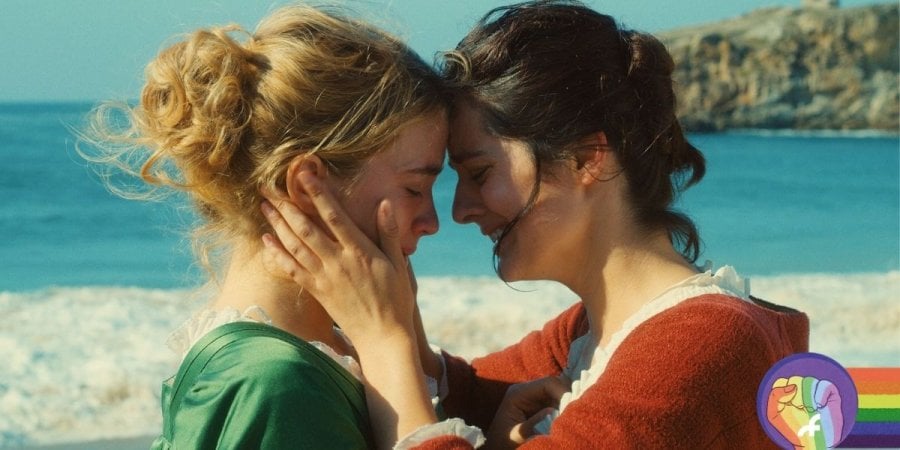
Céline Sciamma’s 2019 film Portrait Of A Lady On Fire is a perfect example of the filmmaker’s artistic concerns. In it, she managed to carve a cinematic space exclusively for women who have often been treated unfairly by the patriarchal nature of the medium. Sciamma derives inspiration from an eclectic mixture of artists, including David Lynch, Chantal Akerman and Virginia Woolf among others.
Sciamma had this to say about her recent masterpiece: “I see [the movie] as a manifesto about the female gaze. I see this as such a strong opportunity to make new stuff, new images, new narratives. They are such powerful images, and they are so not seen. And you are in charge. You have a strong responsibility. But also, there are so many opportunities to be playful. To embody ideas that matter a lot to myself, but also to a lot of people. I see it as a really great dynamic for creating and also very fun visually.”
