


‘12 Angry Men’ explained: Is the defendant guilty of murder?

Sidney Lumet’s 1957 film 12 Angry Men was a league apart from its contemporaries. A 96-minute drama set around the table of a claustrophobic jury room for pretty much its entirety, its minimalist approach relied on the emotional power of dialogue and deft camerawork to capture the imagination of its audience.
The realist techniques Lumet had honed in Off-Broadway stage productions worked a treat, garnering critical acclaim and cult classic status for the movie. The 33-year-old director’s first film would launch a career in Hollywood spanning half a century, and encompass other all-time great pictures such as Dog Day Afternoon and Network.
12 Angry Men was also one of the movies its lead actor and producer, Henry Fonda, would be most proud of making. The profoundly human decency at its core makes it easy to see why. Well, that and the Best Picture Oscar it landed Fonda with.
The film portrays 12 male jurors stuck in a room together, deliberating the verdict of a trial in which a teenage boy is accused of murdering his father. At the start of the movie, 11 of the jurors are convinced the boy is guilty and plan to return that verdict to the court.
Only one, Fonda’s character, believes the defendant is not guilty. The workings of the criminal justice system mean that without a unanimous judgment, the jurors can’t leave the room and deliver their verdict.
So, did the boy do it?
At the start of the movie, the case for convicting the defendant seems clear-cut. The jury discusses how a witness testified she actually saw him do it.
The boy has a clear motive for killing his father. “Ever since he was five years old, his father beat him up regularly,” says Fonda’s character. “He used his fists.” This information hardly strengthens the case for the defence in this instance. It only emphasises that the defendant had a good reason to commit the crime.
Through the course of the film, however, Fonda’s character proceeds to demonstrate the weaknesses in all of the evidence presented to the court. In doing so, he gradually convinces other jurors to change their verdict.

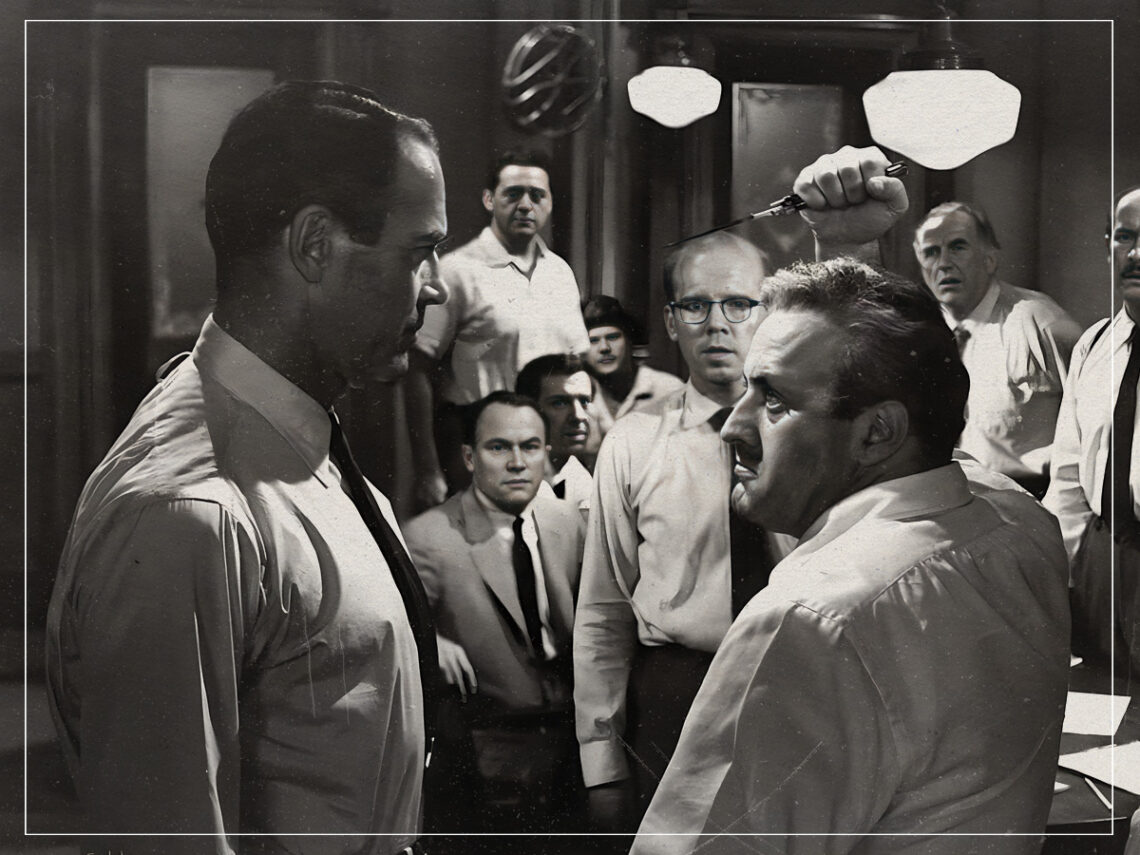
In perhaps the most gripping moment of the drama, as jurors continue to argue on the unlikelihood of someone else other than the boy having acquired the murder weapon, Fonda stabs an identical weapon into the table of the jury room. “It’s the same knife!” one of the other jurors exclaims.
Fonda’s juror explains that he bought his knife cheaply from a shop in the boy’s neighbourhood. In this way, he proves how easy knives of that design are to come by in the vicinity of the crime, contrary to what the guilty-voting jurors had just been insisting.
It gradually becomes apparent that many of the jurors have determined their initial verdict based on their own prejudices and motives. This point is best illustrated when the third juror, played by On the Waterfront actor Lee J. Cobb, reveals his abusive relationship with his own son.
He is the last juror to be convinced to turn his guilty verdict around before weeping over his lost relationship with his son. As he observes earlier in the feel, kids will “work your heart out”. The climactic moment of his breakdown gets to the real crux of the movie.
We never find out conclusively whether or not the boy on trial murdered his father. Only that there is enough “reasonable doubt” about whether he did it or not to convict him. If convicted, the boy would have been sentenced to death by the electric chair.
12 Angry Men sheds light on the risk of this practice leading to the loss of innocent lives, as well as the ideal of ‘innocent until proven guilty’ in a democratic criminal justice system. At the same time, it also wins us over by humanising a dozen otherwise disinterested, irascible and unforgiving middle-aged men.
