


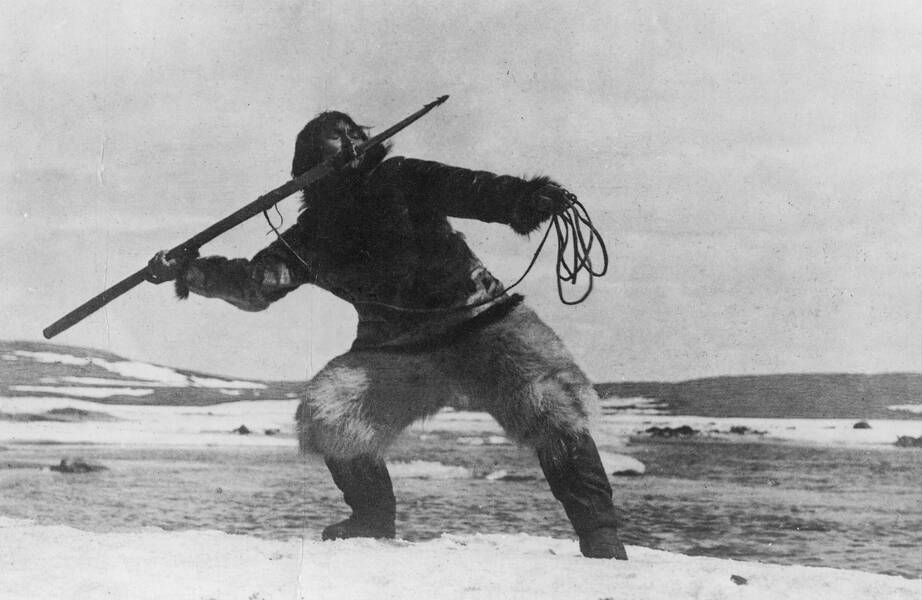
100 years of ‘Nanook of the North’: The world’s first documentary

The documentary genre has evolved at an incredible pace since the conception of cinema. While the first proto-documentaries were single-shots of interesting events, modern documentaries have transcended the limitations of the genre through various innovative ways – ranging from non-linear narrative techniques to postmodern visual structures.
When we talk about the origins of documentary cinema, the discussion always points to one looming figure – Robert J. Flaherty. The son of a prospector, Flaherty established himself as one of the most influential pioneers of early cinema by translating his fascinating expeditions to the cinematic medium.
That’s exactly how Nanook of the North came about, after Flaherty was sent to the Belcher islands by his boss. He attempted to capture the life of the Inuit, but he wasn’t happy with the resultant footage, which worked out for him because the film stock was destroyed in a fire. He later said: “It was utterly inept, simply a scene of this or that, no relation, no thread of story or continuity whatever, and it must have bored the audience to distraction. Certainly it bored me.”
A major point of discussion surrounding Nanook of the North is Flaherty’s approach to ethnographic filmmaking. Although it is cited as the world’s first documentary, Flaherty actually cast the indigenous people as if they were professional actors and staged multiple scenes to dramatise the previously “boring” setting.
When it comes to Nanook of the North, the questions of authenticity don’t matter because the images on the screen are too powerful and important. Flaherty’s hybrid docudrama format is practically indispensable for a wide range of filmmakers working today, from acclaimed independent artists to social media influencers.
The most shocking aspect of the documentary is the brutality of existing in the wilderness. Of course, most of this brutality was delicately engineered by Flaherty, who wanted to build a compelling ethnographic account. The director artificially designed many of the film’s most “dangerous” moments to create an “exotic” aesthetic framework for the Other.
Despite its unethical treatment of its subjects and the audience, Nanook of the North has survived the test of time. Aspiring documentarians revisit Flaherty’s seminal work so that they can learn how to be better than him. That’s exactly why Flaherty’s biggest contribution to film history is paving the way for future documentary filmmakers who were more talented and infinitely more responsible.
Watch the full documentary below.
