


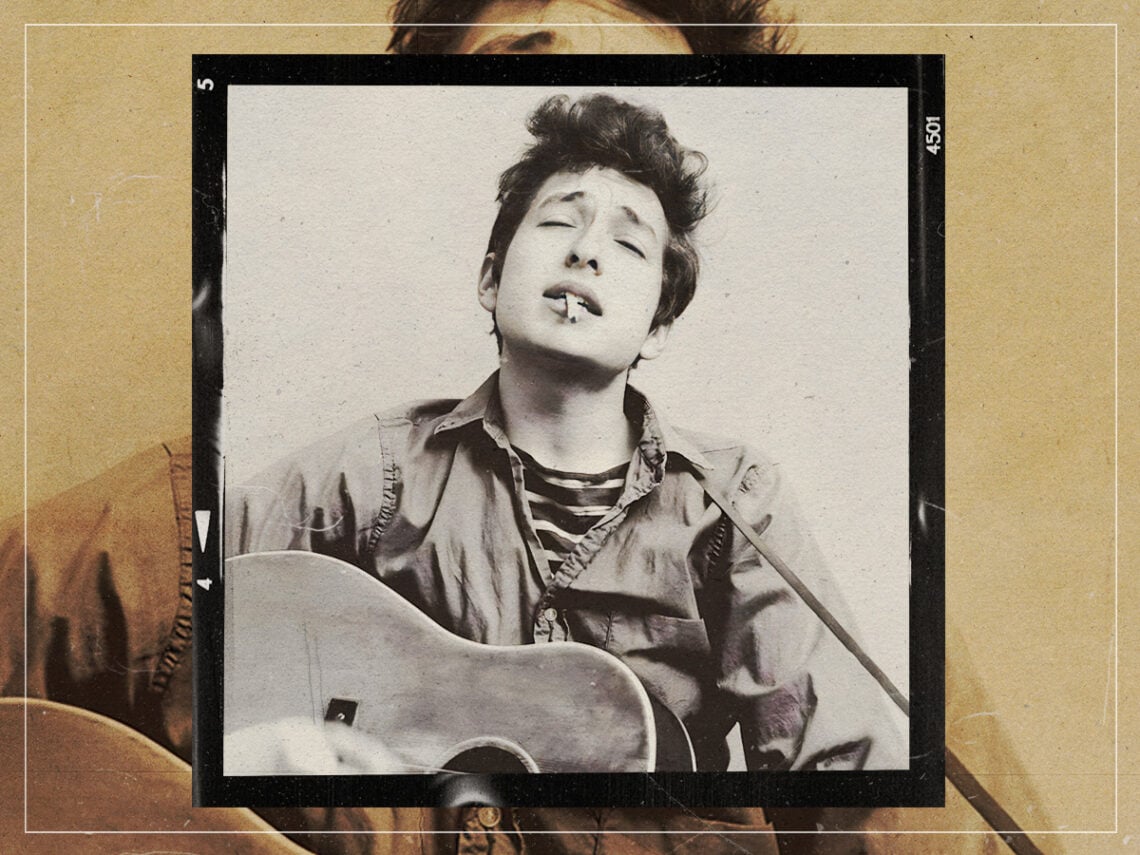
100 years from now: The song Bob Dylan wrote to “defy time”

There are plenty of timeless touchstones in the work of Bob Dylan. When he first emerged, he was labelled ‘The Voice of a Generation’, but there’s no saying which generation that pertained to, so pluralising the attribution would perhaps be more accurate. He is as relevant today as he ever has been. That’s pretty much why he rallied against that title when it befell him in the first place at the tender age of just 22, demonstrating stark foresight and wisdom. Shunning the epithet, he showcased in his music that his mission was to flaunt four chords and the truth, rather than offer support for the next passing fad.
His signature tune, ‘Blowin’ in the Wind’, for instance, might’ve raised pertinent points that applied to the Civil Rights movement, but its message was never hinged on anything specific. So, today, we’re left with a spiritual message that overarches the ages, asking for measured peace and poetic meaning. This sentiment was even closer to the forefront of his thinking when he set out to write a song that specifically looked at the nature of timelessness.
By 1975, he had seen it all and done it all. For the first time, his star seemed to be waning, his muse was faltering, and his own personal life was in tatters. Alas, the lyric he would later write – “wisdom grows up in strife” – springs to mind from what followed. To call Blood on the Tracks his ‘comeback record’ seems rather harsh given that 95% of what came before it was nothing short of golden, but by virtue of timing, it was his best offering since the brilliant New Morning that arrived five years before it, and certainly his most sincere. In that interim, Dylan had purposefully regressed from the limelight, searching for a more normal existence.
“You feel like an imposter when someone thinks you’re something and you’re not,” he would later recall in 2004. Simply put, the times had a-changed, and he’d changed along with them. Sincerity has always been a secret ingredient in his work. He puts himself in them. As the late Sinéad O’Connor said about her favourite track, ‘Idiot Wind’, “That’s why I love Bob Dylan. He’s utterly honest. He can be real fucking nasty.” He had long since reconciled that you can’t be the original vagabond, holding a torch for the “liberated republic” of song, and a young father who just likes to go fishing. But this serene future he had mapped out on New Morning was no longer.
With Blood on the Tracks, he might deny the seemingly apparent autobiographical nature of the songs, claiming they were simply inspired by the Russian short stories of Anton Chekhov rather than his divorce, but all the same, they reflect a time of great anger and upheaval in his suddenly tumultuous life. The nature of his creative muse at the time gave him pause to look at the big picture of his predicament. If there is one thing Dylan has always been great at, it’s playing into his own lore and legacy. For instance, the beauty of a song like ‘I Threw It All Away’ is not just in its daring simplicity but in its daring simplicity in relation to everything he had written before. So, at a time when critics were claiming he’d gone stale and music had moved on, it was a masterstroke for him to roar out of the traps with something so utterly timeless and vital it made punk seem like tedious child’s play.
At the heart of Blood on the Tracks, was a vignette that reflected the album’s allegory as a whole: ‘Tangled Up in Blue’. Two years prior to its release, Dylan had been taking classes from the painter Norman Raeben. “When you look at a painting, you can see any part of it, or see all of it together,” Dylan would later write of his friend’s art. “I wanted that song to be like a painting.”
For the next two years, he toiled away at his timely masterpiece. He would later say, “It took ten years to live, and two years to write,” hoping that it would last for at least a hundred. Wisdom comes from strife, and great art comes from toil; ‘Tangled Up in Blue’ sits at that intersection.
Like brushstrokes on a painting, he looks at life in fragments, all unfurling in the same verse. It’s a garbled mess that seems to relate to life with more veracity than anything linear and neat. To ram this point home he also borrows touchstones from culture. Brooklyn location names, like Montague Street, allude to the last name of Shakespeare’s Romeo in an act of literary romanticism. Alongside this cultural contextualization, he throws in contemporary references to The Beatles, shoehorning in the line “from me to you” and later singing in the same shifted key that the Fab Four deployed, “revolution”.
If you want to get really anal, the official written lyrics also contain the grammatical curio, “Later on as the crowd thinned out / I’s just about to do the same”. The song’s insistence on the use of “I” seems peculiar until you consider that Dylan told Cameron Crowe, “I don’t think of myself as Bob Dylan. It’s like Rimbaud said: ‘I is another’.” Considering that he spent two whole years sweating over ‘Tangled Up in Blue’, the notion that Arthur Rimbaud’s preface that we all contain multitudes was somehow subtly woven into Dylan’s tangle of the blues is not that much of a stretch.
At this stage of his life, Dylan had been the voice of a generation, he had been a poet recluse, an arty father and a bitter divorcee. He’d been lionised, derided, dismissed and misread. All of this seemed to happen without the consultation or reconciliation of the real Robert Zimmerman beneath it all, whoever that was, but it all had irrevocable impacts on his life, nevertheless.
So, the song chronicles random chapters of an infeasible life, throwing shades of the culture that affect it, and the crux of a simple search for love. So, when we look at it like a painting, we see different things depending on our stance. As Dylan told Bill Flanagan of the track: “It was just a concept of putting in images that defy time – yesterday, today and tomorrow. I wanted to make them all connect in some kind of a strange way.”
In this regard, he achieves the timelessness he strived for; not through some quirk of harmonics or avoiding datable trends, but by depicting a tangled web of life that showcases how ‘I’ is all caught up in unfurling circumstance, often the product of the inherent chaos of existence more so than anything controllable. So, he defied time by literally dealing with its unfathomable nature, something we’ll be musing over for many years to come, much like ‘Tangled Up in Blue’, and the mystic poet who blunders through the track like a wayward vagabond fresh from the pages of On The Road.

Never Miss A Tale
The Far Out Bob Dylan Newsletter
All the latest stories about Bob Dylan from the independent voice of culture.
Straight to your inbox.