


The 10 weirdest movie gimmicks of all time

The plot of a film, as well as its cast and crew members, ought to be enough to entice a prospective audience to dispense with their hard-earned cash and head for the cinema. We’re often drawn to films because of their actors or directors, but over the years, certain films have relied on little movie gimmicks in order to sell to audiences.
The idea of the movie gimmick is that the typical viewing experience is enhanced by a unique feature of a given film that audiences will not be able to find elsewhere, with the aim of increasing ticket sales. Gimmicks are not the most popular options for promotion and are primarily associated with films lacking in actual quality.
After all, a quality film, or even just a half-decent one, ought to be able to stand up on its merit through excellent acting or an intriguing narrative. But many films have employed gimmicks such as scratch-and-sniff cards to bring an added layer of sense to a movie, the rumble of seats, or even a theatrical performance during the screening.
Today, we’re looking at ten of the weirdest movie gimmicks ever devised, with several coming from the horror genre. So from the Philippines to Italy and right back round to America, hold onto your seats and let’s get gimmicky.
The 10 weirdest movie gimmicks of all time:
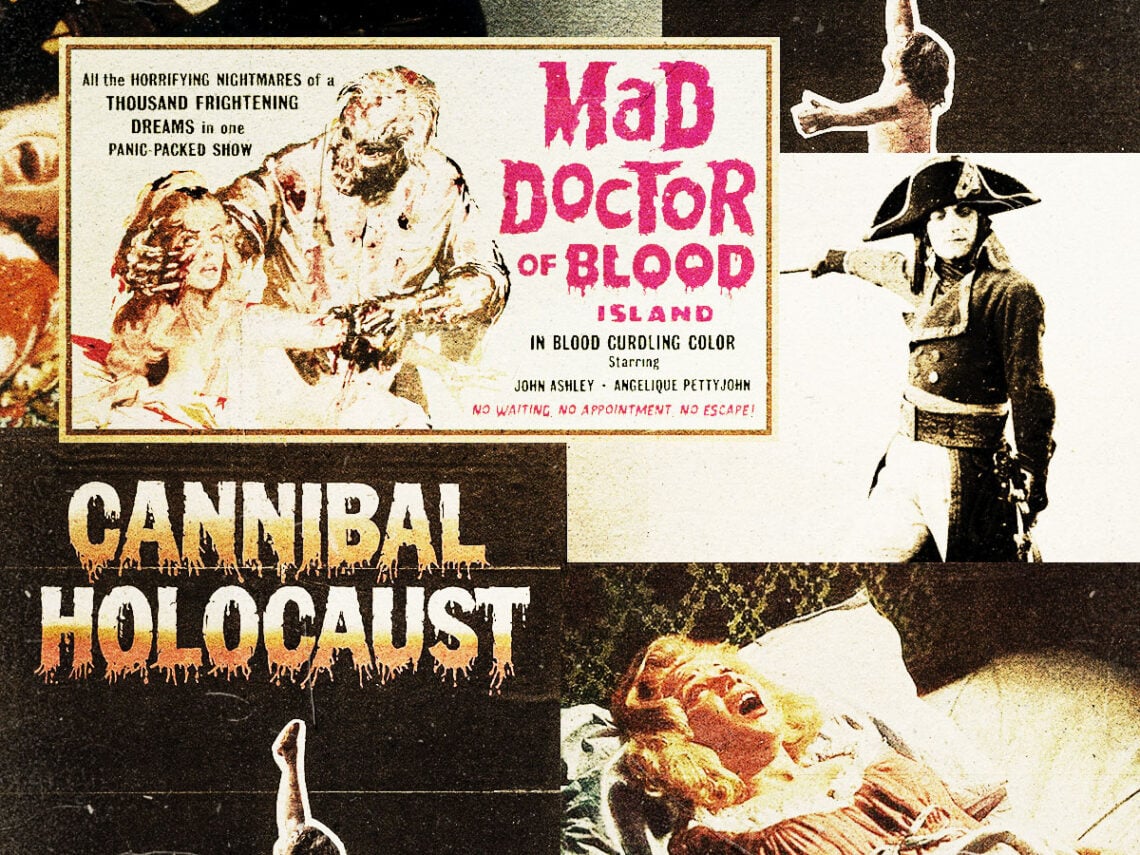
10. The Mad Doctor of Blood Island (Eddie Romero and Gerardo de Leon, 1969)
The brilliantly titled Filipino film The Mad Doctor of Blood Island is the third in a four-part series of horror flicks known as the Blood Island series, produced by Eddie Romero and Kane W. Lynn. Romero co-directed the film with Gerardo de Leon, which tells of a man visiting an island where a mad professor is creating human/plant hybrid mutants with blood from the island’s natives.
Cinemagoers were invited to take part in a ceremony before the film and were given a vial of green “blood”. At some point in the prologue, the audience drank the blood so they could watch the film without being “contaminated”. Well, the gimmick had the opposite effect as many soon got dysentery, including producer Sam Sherman.
9. Polyester (John Waters, 1981)
John Waters has also had an element of shock factor about him, so he’s perfectly suited to a gimmick or two. The 1981 comedy Polyester, again starring Pink Flamingos actor Divine, is a satirical movie about the melodramatic nature of “women’s movies” and mocks the suburban life of the 1980s.
Waters takes aim at themes including divorce, abortion, adultery and alcoholism, but the most significant part of the film was the use of ‘Odorama’. It enabled the audience to smell what they saw on screen, including, but not limited to, feet, gas, glue and, of course, faeces. Great.
8. Napoleon (Abel Gance, 1927)
Perhaps the first gimmick arrived nearly 100 years ago in 1927 with Abel Gance’s epic historical silent movie Napoleon. It, of course, told of the famous French military leader Napoleon Bonaparte and is noted for its innovative use of fast cuts, close-ups, handheld camera work and split screen, amongst many other soon-to-become industry-standard techniques. It also employed a gimmick called ‘Polyvision’.
Polyvision was essentially a precursor to the widescreen format we know and love today, and Gance captured the effect by placing three individual cameras side-by-side during production. The effect in 1927 was captivating if disorienting, and Polyvision was eventually removed from screenings, only showing the middle camera’s footage. Not weird as such, but quite inventive at the time!
7. Macabre (William Castle, 1958)
William Castle was known for using movie gimmicks to promote his works, and one of note arrived in 1958 with the film Macabre. The horror movie starred William Prince and Jim Backus and told of a doctor’s daughter being kidnapped and buried alive, while he is given only five hours to find and save her.
Macabre was one of the first times Castle used a gimmick to promote one of his movies. He thought audiences would be drawn to the cinema to watch the film if they received a certificate for a $1000 “death by fright” life insurance policy made good by the banking firm Lloyd’s of London. Strange, indeed, but it worked!
6. Cannibal Holocaust (Ruggero Deodato, 1980)
Ruggero Deodato’s 1980 horror film Cannibal Holocaust stars Robert Kerman as an American anthropologist who takes a rescue team into the Amazon rainforest in search of a film crew who had been making a documentary on cannibal tribes.
The gimmick behind Cannibal Holocaust was that Deodato made it appear, through the “found footage technique”, that the crew and cast of his actual film went missing, having really been eaten. They had all signed an agreement that they would not appear in another movie for a year. However, the gimmick backfired, and Deodato was arrested on suspicion of actually murdering his cast and crew, which only ended when he brought them into a court of law.
5. Horrors of the Black Museum (Arthur Crabtree, 1959)
The 1959 British-American horror movie Horrors of the Black Museum was directed by Arthur Crabtree and starred Michael Gough as Edmond Bancroft, the owner of a private torture museum. The twist of the movie arrives when Bancroft begins hypnotising people and getting them to perform terrible crimes.
When the film came to America, the distributors felt that the plot was not strong enough to sell to a prospective audience. They hatched a gimmicky prologue featuring ‘HypnoVista’, which saw an actual hypnotist attempt to hypnotise the audience before the film began. Perhaps a bit desperate in this case.
4. Homicidal (William Castle, 1961)
It would be hard not to include more than one film by the master of the gimmick, William Castle, on this list, so we’ve done just that. The second is the 1961 horror-thriller Homicidal, starring Gleen Corbett, Patricia Breslin and Alan Bunce. It tells of a murdering small-town woman in California who is embroiled in the secrets of a prosperous local family.
The big gimmick came in the fact that Castle offered cinemagoers a “fright break” near the film’s end, and audiences could get their money back if they were too scared. However, when audiences did start requesting refunds, Castle retaliated and made them stand in “coward’s corner”, where the scaredy-cats would have to stand with an “I am a bona fide coward” sign around their neck in order to get their cash back in their pockets.
3. Snuff (Michael Findley, 1976)
Michael Findlay’s 1976 film Snuff is arguably the darkest movie on this list and was loosely based on the 1969 murders committed by the Manson Family. After a biker cult-led murder in South America, the end of the film sees the camera switch around to face the crew, and the film’s director then flirts with a female crew member and promptly and savagely tortures and murders her.
The film drew attention because it was marketed as a genuine snuff film, which led to the New York County District Attorney opening an investigation into it. Of course, he found that the murder in the movie was indeed fake, and the added publicity led to the film’s widespread success.
2. Basket Case (Frank Henenlotter, 1982)
The 1982 horror film Basket Case was Frank Henenlotter’s directorial feature debut. It stars Kevin Van Hentenryck as Duane Bradley, a young man who goes after revenge on the medical staff that performed surgery to separate him from his conjoined twin brother, who he keeps inside a wicker basket.
If the film weren’t odd enough, then the gimmick to promote it certainly is. Perhaps tying into the medical theme of the movie, staff handed out free surgical masks upon release in cinemas so that audience members could “keep the blood off their faces”. A nice freebie, at the very least, then.
1. 100 Years (Robert Rodriguez, 2115)
Perhaps one of the most peculiar movie gimmicks is for a film that is actually yet to be released and shall not be for some time to come. 100 Years is a science fiction film directed by Robert Rodriguez and written by John Malkovich. It was produced by the French alcohol brand Remy Martin to promote their Louis XIII cognac.
Billed as “the movie you will never see”, the plot line of 100 Years has been kept secret, but it will be released in the year 2115. Having made several short films for Remy Martin, Rodriguez said of the project, “I finished the first [short film]; I thought that was gonna be a commercial or something. And then I showed them the movie, and they said, ‘Yeah, that’s great, that’s great. That’s the one we lock away.’ And I said, ‘What? That’s the one you lock away? What about the other one with the future?’ ‘No, that’s the commercial.'” Odd.
