


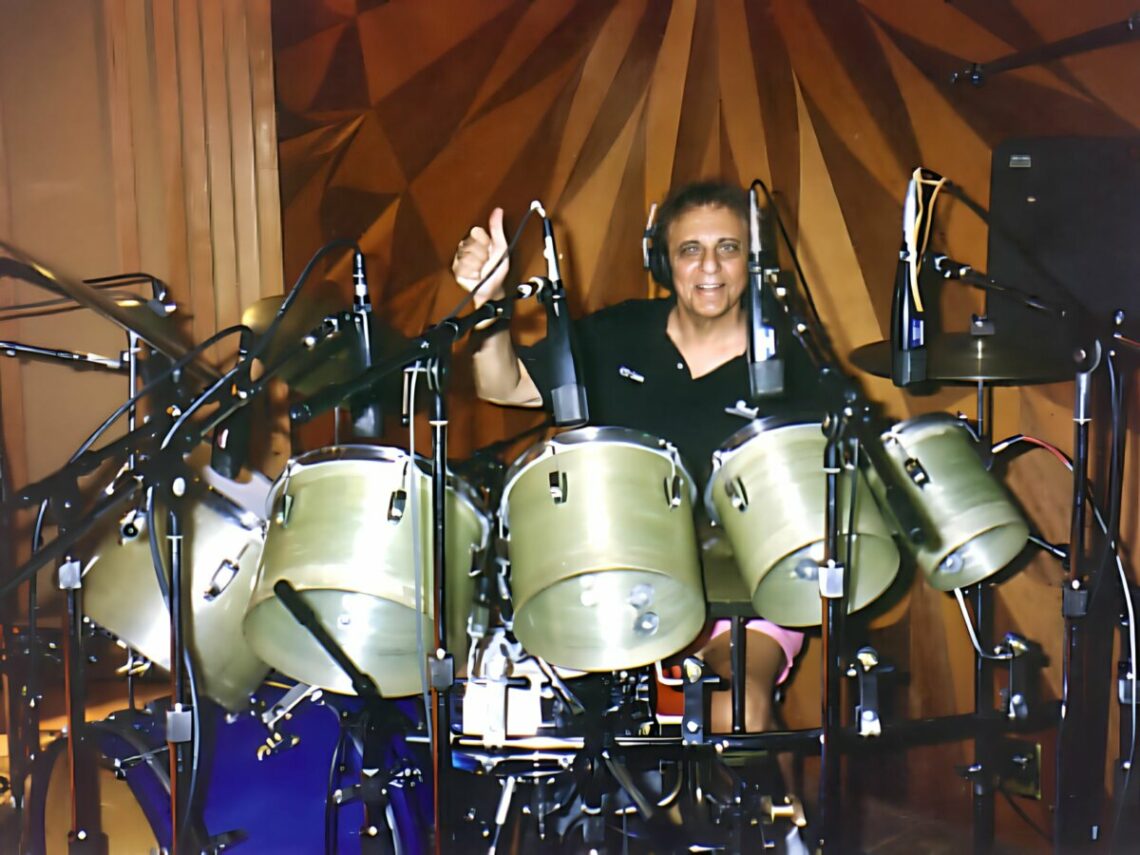
10 unlikely songs featuring drummer Hal Blaine

From the time rock and roll music became the dominant genre of popular music in the mid-1950s, there became a major need for session musicians to help flesh out songs. Most popular acts were solo artists, and even when they had permanent bands, producers often preferred to work with musicians that they knew could do the job quickly and effectively rather than gambling valuable time and resources on unknowns. There was a need for highly skilled musicians with diverse abilities. There was a need for Hal Blaine.
A trained jazz drummer who spent years touring with everyone from Count Baisey to Bobby Sands, Blaine was in the perfect position to make the leap into rock and roll. “A lot of drummers I knew wouldn’t touch rock,” Blaine claimed. “They thought it was dirty and disgusting. To me, playing rock ‘n’ roll was no different than any other form of music. You’re just playing a big backbeat, that’s all.”
By the early 1960s, Blaine had found his most consistent work in Los Angeles, where he and a large group of first-call musicians made up what eventually became known as The Wrecking Crew. Superseding their older counterparts, The Wrecking Crew became the go-to group of players for the likes of Phil Spector, Brian Wilson, Sonny Bono, and most major acts who recorded in L.A. throughout the 1960s.
The sheer scope of Blaine’s recorded work speaks for itself. He played on more than 35,000 recordings and probably has more hit singles than any single musician in the history of popular music. His work on The Ronettes’ ‘Be My Baby’ and The Beach Boys’ ‘Good Vibrations’ became the foundation from which drummers continue to reference to this very day. But Blaine played on a seemingly endless number of songs throughout his career, including some of the biggest hits of all time.
Here are ten songs from Blaine’s illustrious career that you probably know by heart but might not know that he played on.
10 unlikely songs featuring drummer Hal Blaine:
1. ‘A Taste of Honey’ – Herb Albert & Tijuana Brass
Instrumental music was Blaine’s main forte throughout his career. As a session musician, Blaine didn’t need to know or care much about the vocal overdubs that were often happening after he and his compatriots had already exited the studio. So why not make the process easy by not having any vocals at all?
Herb Alpert was making studio albums with The Wrecking Crew in the early 1960s, but when 1965’s Whipped Cream and Other Delights became one of the biggest albums of the year, Alpert actually had to assemble a real band. In the studio, Alpert still preferred The Wrecking Crew, and Blaine continued to feature on the band’s hits.
2. ‘Aquarius/Let the Sunshine In’ – The 5th Dimension
The hippie movement could have spelt disaster for Blaine and his fellow session players. By the end of the 1960s, bands had begun to insist on playing on their own records, with record companies no longer pushing session musicians into the fold. Strangely enough, Blaine found a path through the counterculture by approximating the sounds and styles from it.
The 5th Dimension were making an approximation of an approximation when they recorded two songs from the musical Hair as a medley in 1969. That didn’t matter: it was still a number one hit just as the last embers of the original hippie movement were burning out. Changing times weren’t always easy to navigate for musicians like Blaine, but his ability to adapt proved to be his most valuable asset.
3. ‘Strangers in the Night’ – Frank Sinatra
The Wrecking Crew first came to prominence as younger and hipper musicians compared to their session forefathers. The first-call musicians from the generation before were highly professional, wearing suits to sessions and looking down on rock and roll players. It took a while for the old guard to embrace these new studio players, but one old-school figure who was willing to take them on was Frank Sinatra.
With the encouragement of his daughter Nancy, who had the crew called in to play on her hit ‘These Boots are Made for Walkin’, Ol’ Blue Eyes let the kids have a go at his traditional pop track ‘Strangers in the Night’. Sinatra was so impressed that he called on them again for his next hit single, ‘Somethin’ Stupid’, which he recorded as a duet with Nancy.
4. ‘A Little Less Conversation’ – Elvis Presley
Blaine was a master at hiding hooks in an instrument that couldn’t provide melody. The iconic opening hits to ‘Be My Baby’ are the best-remembered “drum riffs” of his career, but Blaine had plenty of instantly recognisable drum parts from across his career.
Blaine’s funky backbeat to Elvis Presley’s ‘A Little Less Conversation’ was more indebted to funk than it was to jazz or rock music. As a working musician, Blaine needed to be able to play just about anything, and his rollicking breakbeat proved to be a sampler’s dream when house music began to form a decade later.
5. ‘Mr. Tambourine Man’ – The Byrds
The Wrecking Crew might have been beloved by some 1960s rock groups, but others took their appearances as a personal front. They were, after all, hired to replace the musicians whose names appeared on the records. As rock began its transition out of replacing band members with sessions players, one of the final stands came on The Byrds’ first number one hit, ‘Mr. Tambourine Man’.
Producer Terry Melcher didn’t believe that any of The Byrds, with the exception of Roger McGuinn, were capable enough in the studio to record the backing track for ‘Mr. Tambourine Man’. Blaine was called in to replace Michael Clarke and helped provide a bridge between the rock, pop, and folk scenes of the 1960s. By the time the group recorded their second number one, ‘Turn! Turn! Turn!’, the session musicians were out, foreshadowing the change that was to come in the rock scene.
6. ‘The Boxer’ – Simon & Garfunkel
While most rock and folk acts began to favour their own permanent bands and hired musicians, Simon & Garfunkel were one of the few acts who continued to favour hiring members of The Wrecking Crew into the early 1970s. Blaine appears on most of Simon & Garfunkel’s biggest hits, including their final number one, ‘Bridge Over Troubled Water’.
But Blaine’s most memorable contribution to the duo’s canon of work is probably the heavily reverberated snare drum that provided the only percussion in ‘The Boxer’. Channelling the now-antiquated echo chambers that were part of his signature sound in the early 1960s, Blaine provided a major contribution just as he and his crew were being phased out of studio work.
7. ‘I Got You Babe’ – Sonny and Cher
Sonny Bono got his start as a personal assistant to Phil Spector. While helping out for the legendary (and legendarily insane) producer during sessions, Bono saw first-hand what a group like The Wrecking Crew was capable of. By the time he started making records on his own, Bono knew exactly who to call.
The lush backing of ‘I Got You Babe’ was already starting to feel a bit anachronistic by 1965, but Bono was insistent on using Blaine and the rest of the professionals that made up The Wrecking Crew. What nobody knew at the time was that it would be the end of an era, and the start of a new one, for Blaine and his co-conspirators.
8. ‘Guess I’m Dumb’ – Glen Campbell
Blaine first came across country music legend Glen Campbell when Campbell began playing with The Wrecking Crew in the early 1960s. After briefly subbing in for Brian Wilson on tour with The Beach Boys, Campbell decided to start his own solo career, bringing much of the first-call musicians (including Blaine) with him.
“Glen Campbell didn’t really read music,” Blaine later revealed. “He could look at charts and get a sense of what was going on, but everything he did was by ear. When you think about it, though, we all had good ears… good feel, timing. We knew what the songs needed. Of course, we had some pretty good songs to play on, too.”
9. ‘(They Long to Be) Close to You’ – Carpenters
Blaine’s work with the Carpenters proved to be some of his most controversial. That’s because he was replacing Karen Carpenter, a highly talented and capable drummer in her own right. Blaine claimed that Carpenter had difficulty adjusting to the softer dynamics required in the studio, and Carpenter herself signed off on Blaine’s involvement.
However much of that is true, Blaine does bring a delicate touch to the band’s numerous ballads. A song like ‘(They Long to Be) Close to You’ doesn’t work if you have driving drums. It requires a soft touch, something that Blaine could provide in earnest.
10. ‘Annie’s Song’ – John Denver
By the mid-1970s, Blaine and the rest of The Wrecking Crew were beginning to see their opportunities dwindle within the music industry. Some acts, like Steely Dan, still wanted to use the top-shelf session men of the past, but Blaine was among the crowd that was simply getting aged out of the studio. One unlikely supporter was country pop troubadour John Denver, with whom Blaine recorded the number one hit ‘Annie’s Song’.
Blaine remained a collaborator with Denver throughout the 1970s, providing percussion for the live cut that became another number one hit for Denver, ‘Thank God I’m A Country Boy’. Blaine’s work with Denver became some of his final contributions that impacted the pop charts.
