


10 movies that were ruined by one awful character

It doesn’t matter if it’s the protagonist or a minor supporting character; creating an authentic individual to compel your audience is no easy feat. A quality character can entirely carry a movie, with the mystery and allure of their existence providing all the drama a film needs; take Adam Sandler’s Howard Ratner from 2019’s Uncut Gems, for example. However, on the flip side, an awful personality has the ability to derail an entire movie.
Even if everything else works like a finely tuned musical instrument, one character can come into a movie and simply blind the audience, making them forget about dazzling cinematography and wondrous storytelling altogether. More often than not, this is down to the poorly-written characters from the script and not merely the lack of talent from the actors; however, sometimes the two indeed interlace.
In this list, some of the worst movie characters of all time will be explored and exposed. Offering no easy pardon to the greatest filmmakers of the modern era, it’s time to lay bear some terrible writing from the likes of George Lucas, Richard Linklater, Baz Luhrmann and Kenneth Lonergan.
Take a look at the list, which includes a number of classic movies and contemporary surprises, below.
10 movies ruined by one character:
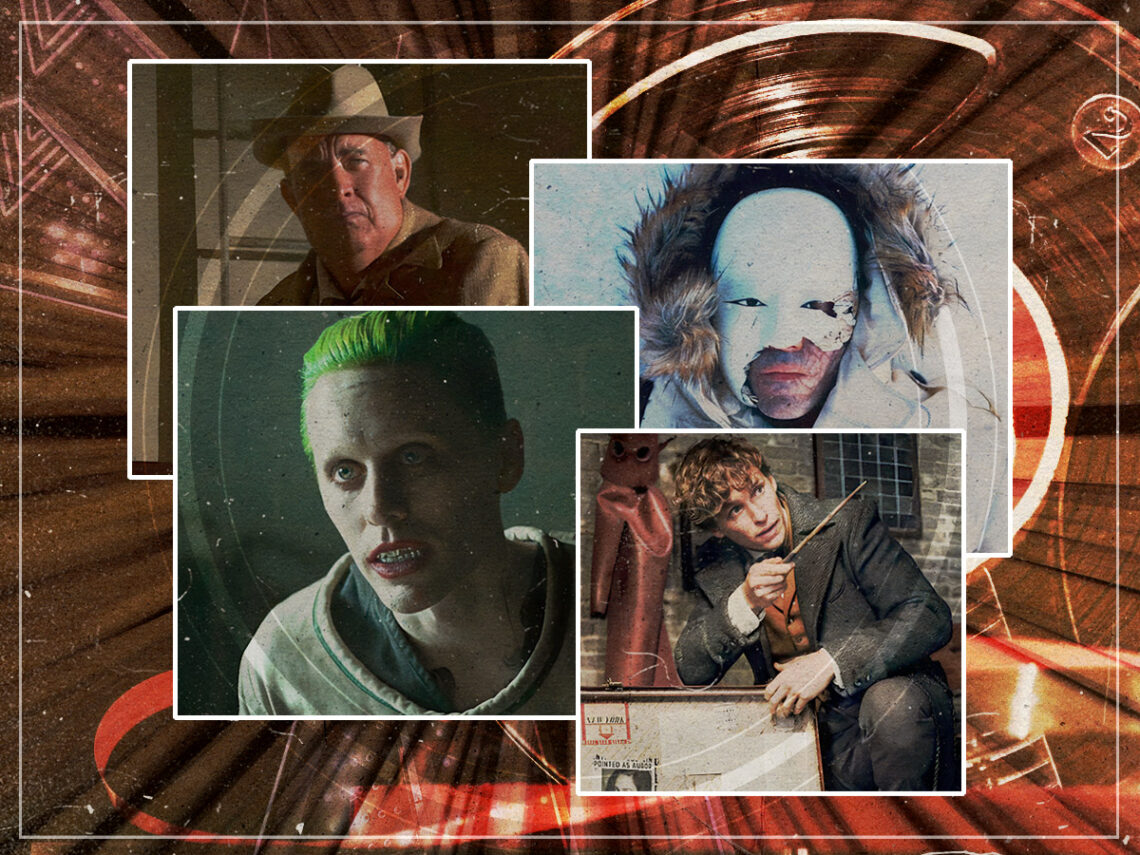
Colonel Tom Parker – Elvis (Baz Luhrmann, 2022)
The 2022 Baz Luhrmann movie biopic about the ‘King of Rock’ Elvis might have been nominated for ‘Best Picture’ at the Oscars, but this doesn’t mean that it’s beyond criticism. Telling the story of Elvis Presley from his humble beginnings to his tragic end, Luhrmann’s film is a rapid highlight reel told in his familiar camp style that features a stellar performance from Austin Butler at the helm.
Yet, dragging the whole film down is Tom Hanks, who gives an embarrassing turn as Elvis’ controversial and eccentric manager, Colonel Tom Parker. Luhrmann doesn’t exactly set him up for success, writing the character as if he’s a pantomime villain with vague, humorous, capitalistic intentions.
I. Y. Yunioshi – Breakfast at Tiffany’s (Blake Edwards, 1961)
There was one point in the late 20th century when Blake Edwards’ 1961 comedy Breakfast at Tiffany’s was championed as one of the best of the genre, yet decades later, nobody really mentions it at all. This is largely for one good reason: the racist character of I. Y. Yunioshi, played by Mickey Rooney.
It’s not difficult to understand why Yunioshi, the Asian landlord of protagonist Holly Golightly (played by Audrey Hepburn), is such an offensive character, with Rooney performing a flagrantly racist Chinese stereotype. Whilst you’d think a white man playing an Asian actor is bad enough, the filmmakers take it to disgusting new levels by giving the actor an offensive wig and buck teeth.
Jar Jar Binks – Star Wars: Episode I – The Phantom Menace (George Lucas, 1999)
The excitement was at a fever pitch in 1999. Fans queued around the block, clad head-to-toe in Star Wars merchandise, to catch the latest edition to their beloved franchise, The Phantom Menace. Notoriously, many of these fans would walk away tragically disappointed, having been given a strange political sci-fi about trade routes and tax authorities that featured one of cinema’s most annoying characters at the centre of it all.
A weird orange combination of a bunny rabbit and a lizard, Jar Jar Binks is frequently named as the one character who brought the Star Wars franchise to its knees, thanks to his irritating jokes and uselessness in the grand scheme of the story. “Jar Jar is the key to all of this,” Lucas famously once stated during the making of the movie, oh, how wrong he was.
Jenny Everdeane – Gangs of New York (Martin Scorsese, 2002)
To many in the world of movie fandom, the American filmmaker Martin Scorsese can do little wrong, having helmed such classic movies as Taxi Driver, Raging Bull and The Wolf of Wall Street. Yet, even the best directors can get things wrong, and 2002’s Gangs of New York is indeed one of his worst movies, telling the story of an eruption of violence between several groups in New York in 1862.
Whilst Leonardo DiCaprio and Daniel Day-Lewis give decent turns as Amsterdam Vallon and Bill ‘The Butcher’ Cutting, respectively, Cameron Diaz is given the short straw for the role of Jenny Everdeane. One of Scorsese’s worst characters, Everdeane is poorly written, being a thin female supporting figure who is given far too little to do, dragging the film down as a result.
Joker – Suicide Squad (David Ayer, 2016)
After Heath Ledger won a posthumous Academy Award for his performance as the Joker in Christopher Nolan’s Dark Knight, the iconic villain suddenly became an avenue for Oscar success in contemporary cinema. With a ‘Best Supporting Actor’ award already in his repertoire, actor Jared Leto saw the role as the perfect vehicle for further success in 2016, appearing as the killer clown in David Ayer’s shockingly bad Suicide Squad.
Despised by both audiences and critics, the 2016 movie was seen as a massive missed opportunity, with many blaming Leto’s awful performance for overshadowing proceedings. A totally unnecessary character in the story, Joker was an annoying wrench in the plot that prevented it from gaining pace and traction.
Willie Scott – Indiana Jones And The Temple Of Doom (Steven Spielberg, 1984)
The globe-trotting Indiana Jones series isn’t perfect; instead, it is praised for its camp approach to pure, joyous action storytelling, but The Temple Of Doom is seen as something of a tonal disaster. Even the iconic filmmaker Steven Spielberg admits the film was a bit much, once stating: “I wasn’t happy with Temple of Doom at all. It was too dark, too subterranean, and much too horrific. I thought it out-poltered Poltergeist”.
But, the tonal issues were just one problem with the movie, with another being the character of Willie Scott, played by Kate Capshaw, a female side-kick who did nothing but scream bloody murder for the entire runtime. This a classic example of how thinly written female supporting roles used to be, many Indiana Jones fans dislike Willie Scott.
Lyutsifer Safin – No Time to Die (Cary Joji Fukunaga, 2021)
Many people consider the reign of Daniel Craig in the role of James Bond to have produced some of the greatest movies in the franchise’s entire history, with 2006’s Casino Royale being a standout favourite. But, despite the strong start, many people forget just how badly Craig’s era ended, with Spectre and No Time to Die both being pretty poor among the royalty of 007 history.
One of the film’s worst and most forgettable aspects was the villain Lyutsifer Safin, played by Rami Malek. Whilst the franchise has created some of the best villains of all time, Safin is undoubtedly one of the very worst, having little conviction at all for his strange intentions, ultimately providing no interest at all in the story.
Mason – Boyhood (Richard Linklater, 2014)
This might be a controversial pick, especially considering that the Richard Linklater 2014 coming-of-age movie Boyhood was nominated for ‘Best Picture’ at the time whilst picking up an Oscar for Patricia Arquette in the process. The nearly three-hour-long movie tells the story of Mason, from a young boy to a college student, with Linklater capturing the real-time growth of the main actor and character over the course of 12 years.
The issue is that no matter how much Linklater tries to make us care about the protagonist, he’s so thinly drawn that it’s impossible to connect with such a bland character. Such is certainly not helped by actor Ellar Coltrane, who is unable to inject any kind of personality into the movie. Mason should be the driving force of the movie; instead, he’s an empty vessel.
Micah – Paranormal Activity (Oren Peli, 2007)
Found footage horror has gained an awful reputation over the years, but for unfair reasons. Sure, it’s an all-too-easy way to make a movie, but there’s no harm in this, especially when such flicks are so utterly terrifying. Oren Peli’s 2007 film Paranormal Activity remains one of the most profitable movies of all time, making $194.2million from a budget of approximately $230,000.
It was a commercial hit and an innovative piece of cinema, but by no means a masterpiece. One of its many drawbacks is the lead character of Micah, who isn’t seen all too often, but when he is, he gives off some of the least compelling dialogue of all time with no thanks to actor Micah Sloat, whose career hasn’t exactly worked out outside of the Paranormal Activity franchise.
Newt Scamander – Fantastic Beasts and Where to Find Them (David Yates, 2016)
As they were steadily released throughout the 2000s and 2010s, it was clear that the Harry Potter franchise was something special, making a profit of over $5.6billion across the course of eight movies. So, when the Fantastic Beasts series started in 2016, Warner Brothers hoped for a similar level of success, only for it to flop on its face, with the Harry Potter franchise now a sleeping giant of contemporary Hollywood.
One of the many reasons why the Fantastic Beasts series doesn’t work is the insufferable lead character of Newt Scamander, played by Eddie Redmayne, a twee, whimsical individual who applies no driving force over the three movies. Doing his best Dr. Who impression, Redmayne gives a weird performance, which put off most fans from even completing the trilogy of films.
