


The 10 most nonsensical twist endings in cinema history

One of the great joys of cinema is a satisfying plot twist. I could list all the best ones, but that would ruin them and be unnecessarily rude, so let’s just rattle off a few titles. Memento, Citizen Kane, The Sixth Sense – all of them have stellar twist endings and set the bar high for everyone else.
A great twist is nearly impossible to pull off. You need to catch the audience completely by surprise while also making them feel that the revelation is inevitable. One hint of manipulation, laziness, or gaping plot holes and you’ll ruin the entire movie, no matter how tense and well-crafted the lead-up is. “It was all a dream” is probably the most annoying of options, but aliens and amnesia are right up there as well.
Twists come in many forms. There are those that illuminate who or what was responsible for something, and those that illuminate a broader “why” of the story. Citizen Kane is perhaps the greatest example of the latter, while pretty much every murder mystery hinges on the former. Most films save the twist for the end, but movies like Alfred Hitchcock’s Psycho and Park Chan-Wook’s The Handmaiden take the even more shocking tactic of throwing them right in the middle.
It would be impossible to list every movie that has a terrible, nonsensical twist. Most of M. Night Shyamalan’s filmography would belong there, as would that extremely irritating moment when we are forced to accept that Princess Leia and Luke Skywalker are siblings despite an entire movie of sexual tension. The movies listed here are some of the most egregious examples. Their twists involve video games, unreliable narrators, aliens, and insects, and, to be quite honest, often turn otherwise dull viewing experiences into so-bonkers-they’re-enjoyable ones.
10 twist ending that are absolute nonsense:
Wild Mountain Thyme (John Patrick Shanley, 2020)
One of the key criteria for a fantastic twist ending is originality. If that were the only criterium, Wild Mountain Thyme would have been a masterpiece. Unfortunately, the twist is so mind-bogglingly strange that it leaves you reeling in all the wrong ways. John Patrick Shanley’s 2020 rom-com stars Emily Blunt as Rosemary, a young farmer in rural Ireland who has been pining for her neighbour, Anthony (played by Jamie Dornan), since childhood. He isn’t interested. In fact, he doesn’t seem interested in much of anything except his own malaise. He slouches around looking sad and arguing about the family legacy with his dad (Christopher Walken sporting an accent of his own design).
Rosemary is suitably confused by Anthony’s disinterest. She is drop-dead gorgeous, runs a farm all by herself, and seems to be first-rate human being by underdeveloped rom-com standards. When she finally confronts him about why he isn’t in love with her, he makes a jaw-dropping confession. He thinks he’s a honeybee. Anthony means this in the most earnest of ways. It isn’t a joke or a metaphor. He is convinced that he is an insect. In the film’s final twist, Rosemary is totally fine with the revelation, and the two live happily ever after.
Now You See Me 2 (Jon M Chu, 2016)
The Now You See Me movies centre around a group of magicians known as The Horsemen who can seemingly do actual magic. Thanks to CGI, there is no attempt to show their practical skills. We are simply forced to accept that they can do anything, including robbing banks on one side of the world while they perform a show on the other. In the first film, the plot twist is that the FBI agent, played by Mark Ruffalo, who is obsessively pursuing the group for their carefully orchestrated heists, is actually the person responsible for them. His goal was to frame Thaddeus Bradley (Morgan Freeman), the man known for his scepticism of magicians and for indirectly causing Ruffalo’s father’s death by convincing him to perform a dangerous magic trick. In the second film, the twist builds on the previous one in even sillier ways.
There is the main plot in which Daniel Radcliffe is a tech billionaire who forces the Horsemen to locate a chip that can control the entire world. The twist, however, is a continuation of the first film: Ruffalo’s character discovers that Bradley (now behind bars) and his father were close friends and associates all along. Bradley has been playing the ultra-long game, masquerading as an enemy to help push Ruffalo to be a magical genius. Sure, why not?
Red Notice (Rawson Michael Thurber, 2021)
There is double-crossing, back-stabbing, and front-stabbing galore in Rawson Michael Thurber’s 2021 crime caper Red Notice. There is so much glitzy globe-trotting and megawatt star power going on that it almost obscures the utter stupidity of the plot, which hinges on the fact that no viewer could possibly keep track of all its twists and turns.
Dwayne Johnson stars as FBI agent John Hartley, who is pursuing Gal Gadot, an art thief known as “The Bishop.” He teams up with her main rival, a conman named Nolan, played by an exhaustingly quippy Ryan Reynolds. They’re all trying to get their hands on a golden egg, and The Bishop swans around in gorgeous gowns, setting them up for crimes they didn’t commit and disappearing without a trace.
Then, in a Nazi bunker somewhere in South America, the truth comes out. Nolan has led Hartley to the egg and assures him that The Bishop will follow and be easily captured. He’s right. But as Hartley handcuffs The Bishop, he leans down and begins to passionately kiss her. They were in it together the whole time. In fact, The Bishop is a joint alias for Hartley and Gadot. Even by the film’s own ridiculous standards, this twist is a bridge too far. Luckily, you will almost certainly have switched off your brain long before.
High Tension (Alexandre Aja, 2003)
The bar for plotting a slasher movie is low. As long as the blood is spurting and the victims are screaming, the audience is willing to put aside any desire for character development or story cohesion. On the rare occasion that twist endings in this genre become a cause for outcry, you can be darn sure that it’s justified. The 2003 French film High Tension is an infamous example.
The story centres on two friends, Marie (Cécile de France) and Alex (Maïwenn), who are innocently hanging out at Alex’s house when an unidentified serial killer shows up and begins bashing her parents’ heads in and slashing their faces with razors. Eventually, after the girls are tortured and traumatized to within an inch of their lives, Marie turns on Alex and accuses her of being the assailant. It turns out that Marie is in love with Alex and can’t stand her lack of interest. All the times we see a man attacking the girls, it is either Marie’s delusions or the story she’s telling the police. It’s one of the most shameless examples of unreliable narration in cinema, and it’s given the film a much larger legacy than it deserves.
Safe Haven (Lasse Holström, 2013)
Romances are rarely the subject of mind-bending plot twists, but Lasse Holström’s 2013 film Safe Haven refused to be reduced to genre conventions or even logic. It stars Julianne Hough as Katie, a woman who is mysteriously running from police and finds safety in a small American town. There, she makes friends with her neighbour Jo (Cobie Smulders), and falls in love with a widower named Alex (Josh Duhamel).
Their affair is put on hold when Alex discovers that his new girlfriend is wanted for murder, but all is right with the world again when she reveals that she is on the run from her abusive husband, a cop who has framed her and is now trying to track her down. That, incredibly, is not the twist. The twist happens after the husband has officially been disposed of and Alex and Katie are able to live happily ever after. Alex gives Katie a letter addressed “To Her.” In it, she discovers that it was written by his late wife to her husband’s future partner. More importantly, however, is that the late wife is Jo. Apparently, it was a ghost story all along.
Perfect Stranger (James Foley, 2007)
Psychological thrillers tend to have stupid twists. It’s practically baked into the genre. The bar, therefore, is extremely low. Nevertheless, James Foley’s 2007 film Perfect Stranger ploughs straight into the proverbial bar, providing an ending that is so annoyingly illogical that it feels like no one was actually paying attention when it came time to resolve the plot. The movie stars Halle Berry as a reporter who goes undercover to try to pin the murder of her friend on a wealthy businessman, played by Bruce Willis.
Berry’s colleague, played by Giovanni Ribisi, is a red herring for part of the story, appearing to be a deranged stalker who may have actually been responsible for the friend’s death. He later confronts Berry to accuse her of the murder, revealing that she and her mother had killed her abusive father when she was a child, and the friend had watched them do it. Decades later, the friend was blackmailing Berry, who decided to murder her to put the matter to rest.
This ending comes out of nowhere and is completely unsatisfying. As it turns out, it was, in fact, completely random. The director filmed three endings, one in which each of the three main characters was the killer. It’s safe to assume that they were all equally terrible.
Serenity (Steven Knight, 2019)
The “it was all a dream” cop-out was given a 21st-century upgrade in the 2019 thriller Serenity. It stars Anne Hathaway as a woman who turns up on a gorgeous island to ask her ex-husband (Matthew McConaughey) to kill her abusive current husband. He reluctantly pauses his quest to capture a giant tuna because he’s worried about the well-being of their teenage son, Patrick. On a fishing trip with the couple, he plans to push the husband into the water for the sharks to eat.
Back home, Patrick is playing a video game. Slowly, it’s revealed that all the characters are just characters in the game. McConaughey, it turns out, was a soldier killed in Iraq. Grieving his father, the boy created a video game about him in which his task was to hunt tuna. When his mom remarried an abusive man, Patrick added them to the video game and reassigned his dad to kill his stepfather. It is an utterly bonkers twist that injects some much-needed weirdness into a film that seems to take itself too seriously until that moment.
The Life of David Gale (Alan Parker, 2003)
The morality of the death penalty isn’t the sexiest of Hollywood set-ups, but no one was stopping Alan Parker from trying it out anyway in the 2003 thriller The Life of David Gale. It stars Kevin Spacey as an activist and academic who campaigns against capital punishment only to be convicted of the murder of a friend and fellow activist. Kate Winslet plays a journalist who is convinced that he is innocent, a hunch made even more credible when she is stalked by a mysterious stranger in a cowboy hat.
The twist is that the murder was actually a suicide. Gale’s friend was dying of cancer, and she and her partner, the aforementioned stalker, created an elaborate ruse to frame him for murder. They planned to release a tape of the suicide to exonerate Gale and demonstrate the dangers of capital punishment. Unfortunately, the tape doesn’t make it to the authorities in time, and Gale is executed. In a final twist, it’s revealed that Gale was in on it, too, and had deliberately left his fingerprints at the faked crime scene.
The implication is that the only way to convince people that the death penalty is wrong is to create an unbelievably convoluted plan that involves the deaths of two innocent people. Some people might argue that the best argument against the death penalty is that, you know, all types of killing are bad.
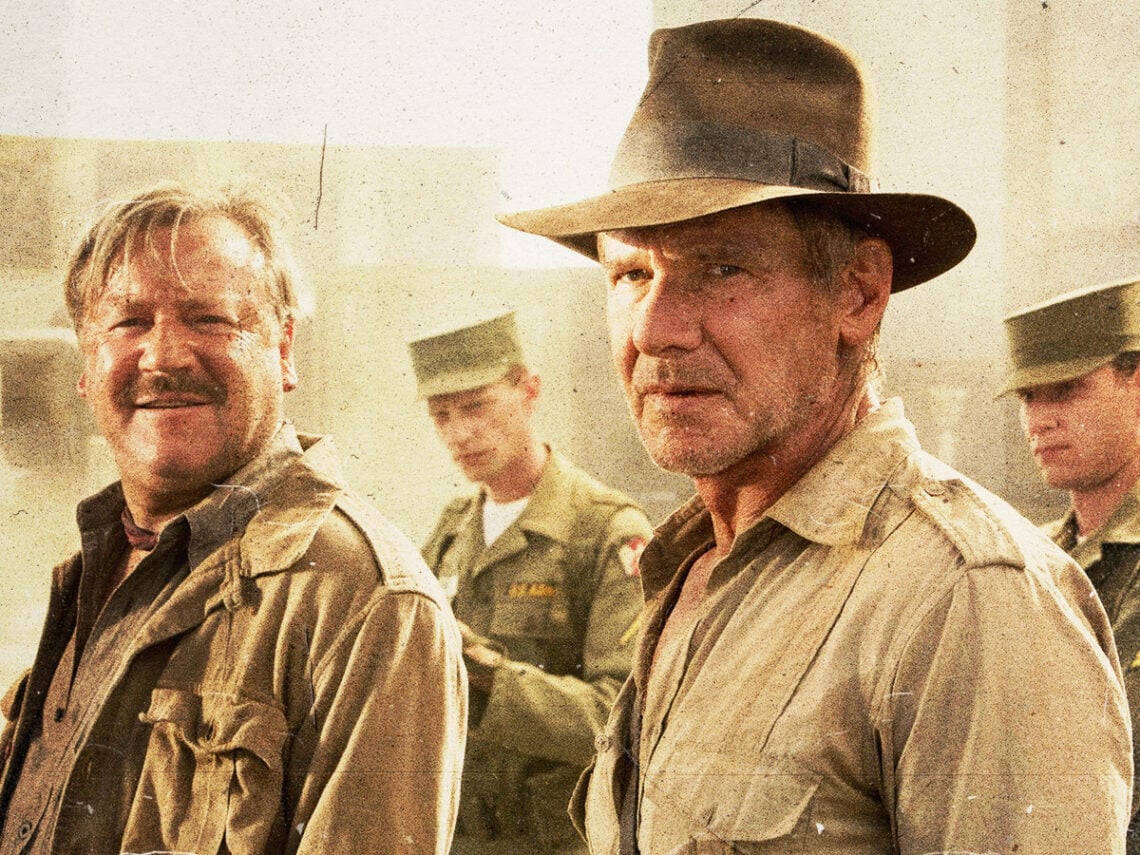
Indiana Jones and the Kingdom of the Crystal Skull (Steven Spielberg, 2008)
People like to pretend that all the Indiana Jones movies leading up to the unwanted 2008 reboot are masterpieces. A quick rewatch of Temple of Doom will remind most viewers that, aside from Harrison Ford’s stunningly ripped physique and Ke Huy Quan’s winning performance, it leaves a lot to be desired. Kingdom of the Crystal Skull stoops lower, especially in its final reveal.
Set in the 1950s, it follows Indie as he tries to out-sleuth Russian spies searching for a telepathic crystal skull somewhere in Peru. It’s a silly set-up, but no more fantastical than finding the Holy Grail or the Ark of the Covenant. Instead of simply finding the skull and destroying the Soviets in gruesome ways, Indie discovers that the skull belonged to a group of ancient aliens. Once reunited with the skull, the aliens come back to life, open a portal, disintegrate Cate Blanchett with a firehose of knowledge, and skidaddle back to outer space in a flying saucer. No one expects gritty realism from the Indiana Jones franchise, but even when previous films strayed into the realm of the occult, it all felt like they were in keeping with Indie’s archaeological work. Aliens should be left in the realm of science fiction.
Righteous Kill (John Avnet 2008)
Any time a movie features Robert De Niro and Al Pacino, it’s a pretty safe bet that it’ll be worth the watch, especially considering the calibre of their previous two films together – The Godfather Part II and Heat. On the face of it, the 2008 crime thriller Righteous Kill seems like pretty predictable fare. De Niro and Pacino play New York cops searching for a serial killer. What could possibly go wrong?
At the beginning of the film, De Niro’s character confesses to being the murderer, explaining that, after several decades, he had decided to take policing into his own hands and start killing bad guys in his own way. The twist is that his confession is actually just him reading Pacino’s diary. Pacino’s character is the real murderer, and De Niro is simply reading his friend’s writing. It’s a twist that is both underhanded and superfluous. With the two stars at the helm, audiences would surely have been happy with a standard police procedural, and if one of them has to be the killer, who cares which one it is?
