


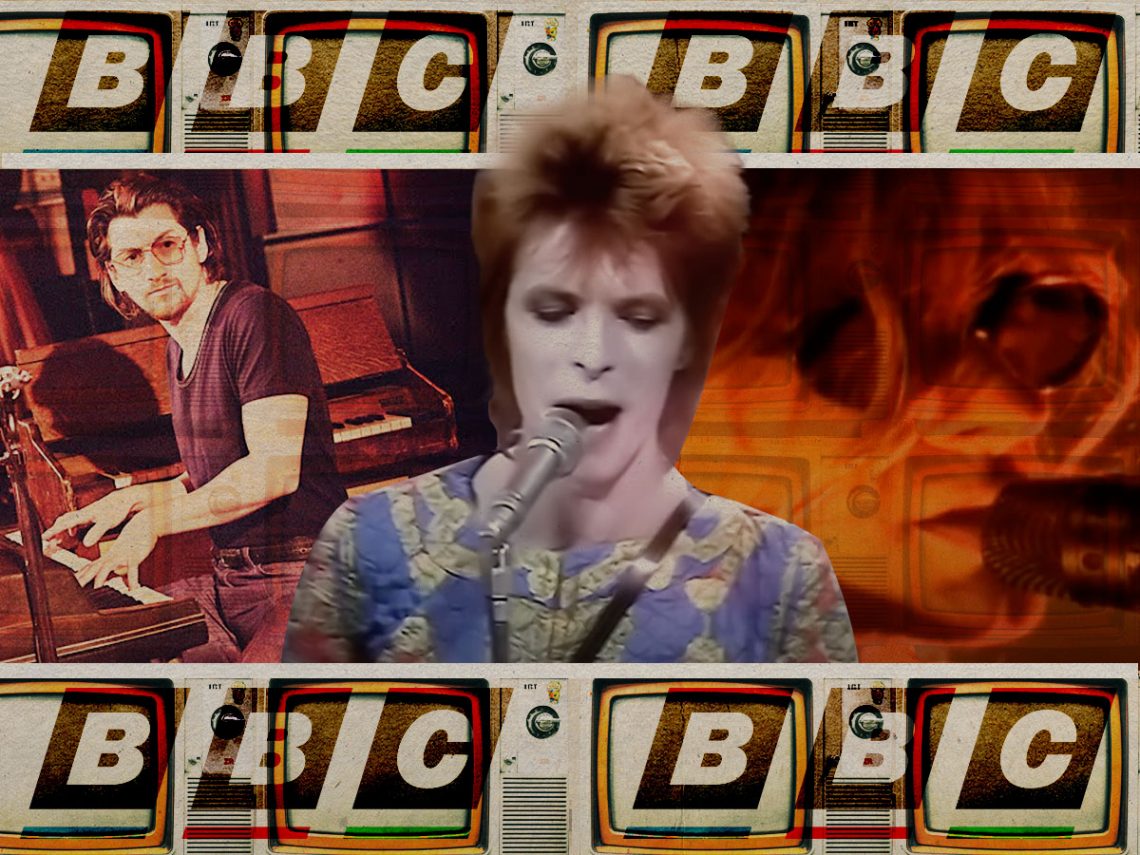
The most iconic music moments from every decade of the BBC

The BBC has been a British institution at the heart of the nation’s cultural output for a century. It has provided countless historical musical moments and has been there to chart how the art form has continuously evolved since its inception in 1922.
Throughout the immense change that has occurred through the timespan of the last century, the BBC has been a reassuring, constant presence. It’s a bedrock of the British music scene and the link that ties together every great homegrown act in contemporary rock ‘n’ roll history.
Although the power of the BBC as tastemakers has dwindled as our collective listening habits change, it still occupies crucial cultural ground. It’s there throughout an artist’s journey, usually giving them their first break on BBC Introducing in their local area before they graduate to a national station, perform a session on BBC Radio 1 or 6 Music or play on Later…With Jools Holland.
Furthermore, the BBC is also home to Glastonbury, which it beams into households across the country. Without the broadcaster’s influence, it wouldn’t have become the world’s favourite festival, allowing millions to have Worthy Farm in their front room.
To celebrate 100 years of the BBC, we chart the most important musical moments in the broadcaster’s history below.
The most important musical moments in the history of the BBC
1920s
1922 was a big year for culture. James Joyce published Ulysses, F. W. Murnau unleashed his vampiric horror film Nosferatu, and The BBC made its first-ever broadcast. From the beginning, the establishment prided itself on sponsoring new music, stating that its mission was to be “ahead of the public, but not so much as to lose their confidence.”
In 1927, The BBC took over the annual Proms. In that first year, Sir Henry Wood and his Symphony Orchestra performed a selection of old favourites and pre-modernist crowd-pleasers. Apart from the odd recent work by Ralph Vaughan Wiliams, Gustav Holst or Elgar, there wasn’t much in the way of contemporary music. That being said, on August 17th, 1927, the BBC broadcasted a performance of Concerto for Violin and Horn by Ethel Smyth – the most accomplished contemporary female composer in an otherwise male-dominated environment. For obvious reasons, the original recording no longer exists, but you can hear an example of Smyth’s work below.
1930s
In 1928, The BBC formed its own Dance Orchestra, which began under the leadership of Jack Payne before Henry Hall took over in 1932. This marked the beginning of a golden period both for the BBC Dance Orchestra and Big Band jazz in general.
Indeed by 1939, the BBC was broadcasting its own swing sessions, which often featured performances by the likes of Billy Cotton, Benny Goodman, Joe Loss and Jack Hylton, many of whom would go on to become celebrities in their own right. Here, you can hear The BBC Dance Orchestra performing a string of hits shortly after the declaration of war in 1939.
1940s
Following the outbreak of the Second World War, the BBC was forced to reduce its hours of service and rely on its own musical devices. The first edition of Music While You Work was aired on June 23rd, 1940, and was advertised as “ a half hour’s music meant specially for factory workers to listen to as they work”.
Broadcast twice a day, the first programme featured theatre organists like Dudley Beavan in the morning session and the organ trio The Organolists in the afternoon. Basically, there was a lot of organs. As it became increasingly popular over the course of the war, however, it began introducing livelier dance music that could be heard among the clatter of the factory floor. There was even the odd rhumba.
1950s
In April 1958, The BBC launched its enormously influential Radiophonic Workshop. Based in Room 13 of Maida Vale Studios, London, the organisation was responsible for crafting some of the earliest (and most memorable) electronic sounds and soundscapes, including the Doctor Who theme tune, for which we have electronic pioneer Delia Derbyshire to thank.
In the early days, the workshop’s sonic experimenters were charged with crafting effects for radio, with a particular focus on experimental “radiophonic poems”. The organisation’s early output also included effects for sci-fi serials like Quatermass and the Pitt and ludicrous comedy sounds for the immensely popular The Goon Show.
1960s
By 1962, The Beatles had already made numerous appearances on independent radio and TV stations around the UK, making it to the Big British Castle in the March of 1962, when they recorded their radio debut. The performance was for Teenager’s Turn, a new light program dedicated to pop music.
Donning suits for the very first time, The Beatles made their way to the studio after a furious afternoon rehearsal. On arrival, they performed three cover songs doing well in the American charts at the time: ‘Memphis, Tennessee’, ‘Please Mister Postman’ and ‘Dream Baby (How Long Must I Dream?)’. The broadcast, which aired between 5 and 5.30pm the following day, marked the beginning of The Beatles’ long and mutually-beneficial relationship with the BBC.
1970s
David Bowie defined the 1970s, and the BBC played an integral part in his rise from fledging status to superstardom. His story with the broadcaster began on February 5th, 1970, when he was invited to record a session for John Peel on Radio 1, which opened Bowie to a whole new audience.
Peel was Britain’s most important tastemaker, and Bowie won him over with his first session. Interestingly, unlike every other appearance he made at the BBC, Bowie was still relatively unknown when he featured on ‘The Sunday Show’ and wasn’t given the red carpet treatment. Bowie’s session for ‘The Sunday Show’ was tragically wiped and readied for reuse. However, thankfully, it was eventually recovered, and you can listen to it below.
1980s
Similarly to Bowie, The Smiths were also given their big break by John Peel. One of the DJ’s producers, John Walters, had seen the group perform at a Student’s Union in London and told Peel to bring them in for a session. It was immediately popular with the programme’s loyal listeners, and the Manchester group seemingly built a close relationship with the show.
In Morrissey’s autobiography, he revealed Peel never came to see them perform or even attended a session. The singer wrote, “If not for the continual exuberance of John Walters, John Peel could never have encountered the Smiths.” Yet, despite not being a fan of the group, Peel was pivotal in The Smiths’ story, and their first session is one for the history books.
1990s
Although Top of the Pops was losing its relevancy by 1991, and it was no longer as important as it was when The Beatles graced the stage, Nirvana’s takeover of BBC Television Centre was an important cultural moment. Typically, bands would mime to a backing track while their frontman sang, which was a notion the Seattle group poked fun at with their performance.
Krist Novoselic threw his bass around like a shotput; meanwhile, Dave Grohl danced like a madman behind the drum kit. Additionally, Kurt Cobain hilariously changed the opening line of ‘Smells Like Teen Spirit’ from “load up on guns, bring your friends” to “load up on drugs, kill your friends.” The singer then proceeds to eat the microphone, which makes for an unsavoury sight. Although the performance was controversial, it made Top of the Pops important once more.
2000s
The BBC were one of the first to get behind the generational talent of Amy Winehouse, and they provided her with a national platform to express her brilliance to the country. In 2003, Winehouse appeared on television for the first time and performed a hauntingly beautiful version of ‘Stronger Than Me’ on Later…With Jools Holland.
Holland later selected the performance as one of his all-time favourites and said: “I think Amy Winehouse was one of the greats. Her voice was amazing, it was just very great when you heard her sing. I remember Paul Weller once when she was on one of our shows, and the notes came out, and him thinking, ‘Wow, that’s something’. There’s a handful of great singers that have that thing.”
2010s
The Old Grey Whistle Test originally ran from 1983 until 1988, but thirty years after being taken off the air, it returned for a one-off special featuring the Arctic Monkeys. For the band’s sixth album, Tranquility Base Hotel & Casino, they kept promo to a minimum but found time for a BBC session in 2018, which paid homage to the historic programme.
The mini-concert celebrated their career so far, charting their journey from boys to men. It was also fitting they paid tribute to the vintage music show, as it’s namechecked in the lyrics to ‘Four Out Of Five’. On the track, Turner sings, “Lunar surface on a Saturday night, dressed up in silver and white, with coloured old grey whistle test lights.” Furthermore, the video to their breakout single, ‘I Bet You Look Good On The Dancefloor’, is also shot to look like the Old Grey Whistle Test.

Never Miss A Beat
The Far Out Beatles Newsletter
All the latest stories about The Beatles from the independent voice of culture.
Straight to your inbox.