


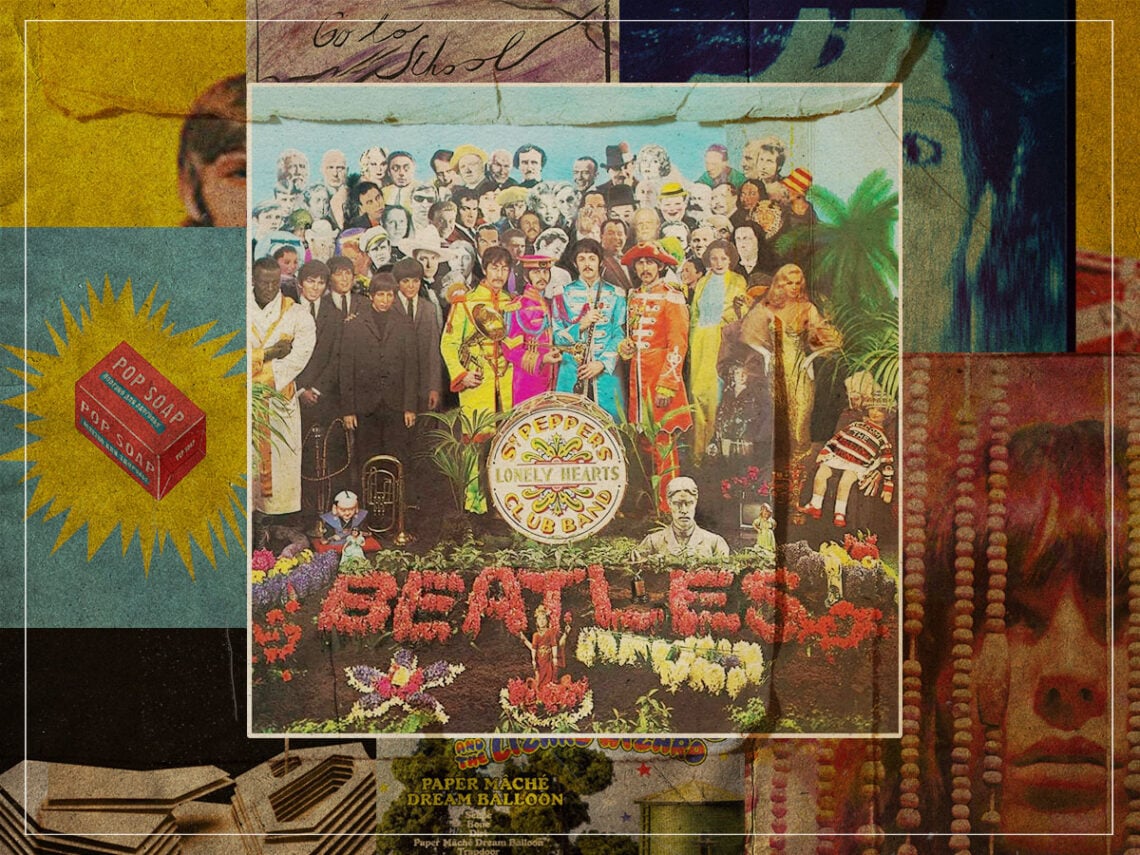
10 modern albums that capture the essence ‘Sgt Pepper’s Lonely Hearts Club Band’

Without too much exaggeration, it can be claimed that there was music before Sgt Pepper’s Lonely Hearts Club Band and there was music after Sgt Pepper’s Lonely Hearts Club Band. With this monumental album, The Beatles branded the timeline of cultural history with an indelibly distinct new waterline. And it isn’t even their best record.
However, where it triumphs irrefutably – the reason why it is so fervently revered – is tied to its unrivalled outlook rather than its quality. The album is a behemoth piece of work. Of course, there are magnificent tracks therein, but the height of its artistry is its scope. With the record, they pioneered a huge array of ‘firsts’ in music. It defined what ‘visionary’ would come to be seen as in modern art.
But where is its more direct influence in the present? The albums certainly pioneered advancements in-studio sound that are now ubiquitous in the trade. But to some degree, these shifts were technological more so than artistic. In fact, David Bowie claimed that records like The Velvet Underground echo louder in an artistic sense in today’s music than Sgt Pepper.
While it’s hard to say that’s entirely true given that the Fab Four’s record inspired every artist who heard it to reach further with their sound, its scope was so large few have feared to tread down the trail it blazed. However, a few modern acts have given it a go. With that in mind, we’ve picked out the contemporary records that every Sgt Pepper’s fan should be well aware of.
10 modern albums for fans of Sgt Pepper’s Lonely Heart Club Band:
Go To School by The Lemon Twigs
The Lemon Twigs boldly opted to go down the musical theatre route with their second studio album. That bold move alone is inherent of The Beatles’ own unwavering determination to be daring in a way that wasn’t always ‘traditionally’ cool. But more so than that, with a musical theatre concept record, both scope and story are of equal importance.
This meant that for Go To School, the production had to be dramatic, and arrangements had to chart a vast scope, but the D’Addario brother’s own vocals had to sit firmly on top of the mix. This is a feat that The Beatles also pulled off on Sgt Pepper. While the record might be noted for its density and size, at no point are the band members subsumed by that—they ride it like a surfer rides a wave, creating something as personable and emotive as it is impressive.
Manipulator by Ty Segall
Blending psychedelia with a heavy blues heart, Ty Segall‘s seventh record has all the adventurous spirit of Sgt Pepper but with a garage rock ruggedness and a darker heart. The Californian musician has been releasing solo records since he befriended John Dwyer of Thee Oh Sees back in 2008, and the frontman was impressed enough to offer to release Segall’s debut on his own label.
Since then, Segall’s output has been a scattered smorgasbord, constantly defined by his ability to find hooks within chaotic exploration. With Manipulator, there is a distinctly John Lennon-like mishmash of darkness and light. Tracks like ‘Tall Man Skinny Lady’ have all the hallmarks of ‘Good Morning, Good Morning’ and its playful flirtations between harmony and dissonance, prettiness and effrontery.
Paper Maché Dream Balloon by King Gizzard and the Lizard Wizard
When it comes to progressive scope, King Gizzard and the Lizard Wizard are relatively unrivalled. They are determined to push boundaries, effectively fashioning themselves as a fully-fledged multi-media project, creating their own world with 26 albums released in 12 years—each of them coming with idiosyncratic artwork, and a distinct artistic style, despite wavering genres. This ethos alone is positively Beatleseque.
However, the record that ran closest to the bombastic pop-come-neo-classical madness of Sgt Pepper’s was their seventh effort, 2015’s Paper Maché Dream Balloon. Its musicological core is pure pop and the basis of its outlook is environmental concerns. However, that core is riddled with jazzy tones, comic irreverence and simple sense of playfulness that harks back to what made The Beatles’ studio days so stirring.
Melody’s Echo Chamber by Melody’s Echo Chamber
It is safe to say that Kevin Parker of Tame Impala fame has made his mark on the sound of this century in a manner not too dissimilar to how the Beatles dominated the 1960s. Like the first Neanderthal to chuck salt in their stew, there has been at least a pinch of his work in everything that has followed. He started spreading his influence early when he teamed up with Melody Prochet to alchemically cook up her solo debut with a finely harvested sonic atmosphere from the floating ether around his homely Perth studio.
The heady mix of their brew is an intoxicating one. While it might be clear at times that studio experimentation has sneaked to the forefront and songwriting has slipped to the wayside, it still proves to be a highly involving listen all the same, capturing the sense of nothing ventured nothing gained at the heart of Sgt Pepper. The album takes space-age crafting and imbues it with an almost outsider-music-esque vibe in a manner akin to its 1967 predecessor.
You’ll Have to Lose Something by Spirit of the Beehive
An utterly visionary piece of work, the latest album by Spirit of the Beehive races forth in the same spirit as the groundbreaking Sgt Pepper’s. This intent does mean that it’s not immediately easy on the ear. The density of the record can make it feel like a weight you can’t be arsed to lift on the odd occasion. But it lives by this same sword and, ultimately, triumphs as a result.
The musical scope is monumental on You’ll Have to Lose Something. Like the Beatles, the band are not tied to their own instruments, delving into expansive arrangements at will. In a futurist whirl, there are chopped up samples, strings and genre-blending aplenty. However, in the true spirit of the Fab Four, this is done with hooks and pop at its core.
Pop Soap by Kosmetika
Pop Soap by Russian-Australian band Kosmetika is a spaced-out concept album that deals with issues of commercialism and politics while mingling post-punk, psychedelia, and a certain comedic angle which evokes the same sort of vibe as Sgt Peppers‘ own unique mix of irreverence, unbound creativity, and sternly important core. At the heart of both albums is an inherent sense of just how joyous art can be.
“To be honest, I don’t think Pop Soap is about anything specifically or has a strong concept,” frontwoman Veeka Nazarova told Gimme Zine in a fitting appraisal. “It’s a collection of ideas”. Much like the Beatles before them, the crux of that collection is a sense of identity. The album unfurls like a cosmic mood board, both vast and deeply human at the same time.
We Will Always Love You by The Avalanches
As was hinted at by the ‘dream audience’ on the cover, Sgt Pepper’s was a record that celebrated inspiration and collaboration like no other. For the album, The Beatles welcomed an arsenal of session musicians, put huge faith in George Martin to orchestrate their lofty arrangements, and attempted to honour everything that was feeding their muse at the time. This is a spirit that The Avalanches have also always lived by.
For their third record, a journey of cosmic scope, they welcomed in everyone from Blood Orange and Johnny Marr to Vashti Bunyan, Leon Bridges and Kurt Vile. By no means was this done cynically in the manner of many modern collaborations aimed to unite two fanbases, but rather to explore the full spectrum of modern music, painstakingly pieced together like everything The Avalanches have released over the years.
On All Fours by Goat Girl
Great art endures, and some of the best of that great art changes over time, too. This is a sorry reality that has left many critics red-faced as they focus on immediacy and struggle to see the swell. Even Sgt Pepper’s was criticised upon release by some foolhardy folks. Similarly, with On All Fours, the London quartet Goat Girl produced a record that just keeps giving as you fall for it one hundred times over the more it reveals itself to you.
This is an opinion shared by Conor Curley of Fontaines D.C. Recently, when we were discussing our mutual love for the record, he told me: “I love that album On All Fours,” he said of Goat Girl’s 2021 swirling wave of genre-blending brilliance featuring anthemic tunes like ‘Sad Cowboy’. “I listened to it when it came out but since then I’ve got so much more into it. I feel like it’s made sense to me more, I feel like I’ve gotten to the place where I understand it more. It’s amazing, man.” This truth offers a glimpse of the amorphous sound of the record and the depth of sensibility behind it.
Return to Cookie Mountain by TV On the Radio
Return to Cookie Mountain comes roaring to the door like an excitable golden retriever. To begin with, it proves so manic that you might have to lock it away for a moment so that it settles down. Rarely does an album begin with the same level of discordance as the opener ‘I Was a Lover’, and that can prove overwhelming before you even truly begin.
However, in time, the drip-feed of moments where everything aligns, and harmony breaks out from the urban rubble is a beautiful thing to behold—and it feels deftly inspired by the chaos and harmony of ‘A Day in the Life’. The Brooklyn-based band are first-rate musicians, and Dave Sitek is one of the finest producers around. This pedigree means that triumphant melodic synchronicity and edgy experimentation can be mixed seamlessly to make a record that might not be the most pleasant in your collection, but it will certainly be up there among the most musically interesting.
Tranquility Base Hotel + Casino by Arctic Monkeys
Not only did Sgt Pepper’s showcase The Beatles’ desire not to be upholding to the past, it also clearly demonstrated that they wouldn’t be upholding to their former selves either. With the record, they, both conceptually and in an evolutionary sense, became a different band. Few acts have followed this adventurous mantra quite like the Arctic Monkeys.
For their 2018 record, they absconded to the moon and reinvented their sound to match the lunar excursion. In doing so, like The Beatles before them, they managed to delve into their latest set of inspirations. This time, their muse was focused on the information-action-ratio of the digital age—a prescient subject that looked to steal some of the zeal of the unfurling zeitgeist in a similar manner to how the final howls of ‘A Day in the Life’ mimicked the inevitable crescendo of the 1960s reaching it’s chaotic end after a rumble of unsustainable energy.

Never Miss A Beat
The Far Out Beatles Newsletter
All the latest stories about The Beatles from the independent voice of culture.
Straight to your inbox.