


10 essential films from the ‘Slow Cinema’ genre

Films from the ‘Slow Cinema’ genre are often characterised by their meditative approach to art, choosing to indulge in long takes and reflect on what’s within as well as what’s outside the frame. Instead of focusing on the narrative, these works explore the world through minimalist philosophies and patience that is suited for a treatment of time and space that is rooted in realism.
One of the icons of the Slow Cinema genre, Theo Angelopoulos explained: “If we mean the choice to work with long takes I must say that it was not a logical decision but a natural choice. A need to incorporate natural time in the space as a unity of space and time. Space that becomes time. A need for the so-called dead time between the action and its anticipation, which is usually eliminated in the cutting room by the editor, to function musically like pauses. A perception of the shot as a living cell that inhales, delivers the main word and exhales. A fascinating and dangerous choice that continues to the present day.”
Adding, “The use of long takes is usually considered theatricality on a superficial level. What are known in the French terminology as ‘plans-séquence’ (sequence shots). In these shots, when they unfold in an interior space, the space appears to take on the character of a scene and the actors move freely, as though on the stage of a theatre. These characteristics give the person looking at it narrowly the impression of theatricality. But that’s not what defines theatricality. If I were to attempt to define it I would say that it is a degree of hyperbole, as regards speech and movement.”
In this latest addition to our weekly column on world cinema, we explore 10 essential films from the Slow Cinema genre from all around the globe in order to evaluate how these unique artistic sensibilities have been translated to the cinematic medium.
10 essential films from the ‘Slow Cinema’ genre:
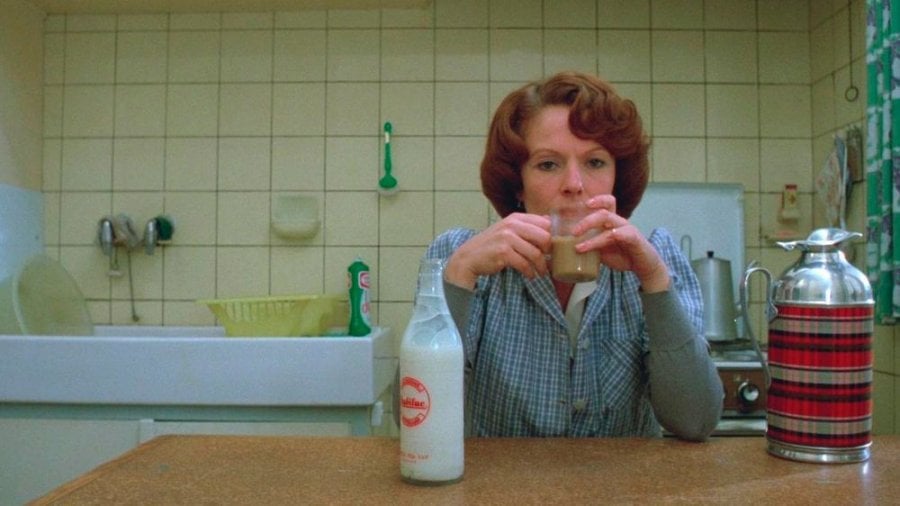
Jeanne Dielman, 23, quai du Commerce, 1080 Bruxelles (Chantal Akerman – 1975)
Chantal Akerman’s 1975 magnum opus is (in)famous for its depiction of a housewife’s life because it stays true to a sense of monotony and Sisyphean suffocation that is all too real. Dubbed as the first feminist masterpiece in the history of cinema, the film launches an existential exploration of what it means to be a woman who is trapped within the confines of tradition as well as modernity.
Akerman commented: “When you’re editing, something happens that tells you this is the moment to cut. It’s not theoretical, it’s something I feel. Afterward, explaining it is always very difficult. In the beginning, especially with Jeanne Dielman, a lot of people thought I was a great theoretician. Quite the contrary. Later, when people would meet me, they’d realise that. Everyone thought, for example, that Jeanne Dielman was in real time, but the time was totally recomposed, to give the impression of real time.”
Stalker (Andrei Tarkovsky – 1979)
This celebrated 1979 sci-fi film is perhaps the crowning achievement of Andrei Tarkovsky’s illustrious filmography. It is a glorious cinematic attempt to establish an alternative dialectic, told through the story of a “Stalker” who leads a writer and a professor to an illusory truth. Stalker is one of the few films that gives us a glimpse of the void and manages to make it revelatory.
“Why doesn’t it matter where he arrived? Because the path is infinite,” Tarkovsky said. “And the journey has no end. Because of that, it is of absolutely no consequence whether you are standing near the beginning or near the end already — before you, there is a journey that will never end. And if you didn’t enter the path — the most important thing is to enter it. Here lies the problem. That’s why for me what’s important is not so much the path but the moment at which a man enters it enters any path.”
He added, “In Stalker, for example, the Stalker himself is perhaps not so important to me, much more important is the Writer who went to the Zone as a cynic, just a pragmatist, and returned as a man who speaks of human dignity, who realised he was not a good man. For the first time, he even faces this question, is man good or bad? And if he has already thought of it — he thus enters the path… And when the Stalker says that all his efforts were wasted, that nobody understood anything, that nobody needed him — he is mistaken because the Writer understood everything. And because of that, the Stalker himself is not even so important.”
Sátántangó (Béla Tarr – 1994)
Tarr’s notoriously bleak vision is on full display in this seven-hour film which explores the lives of villagers who find themselves trapped within the volatility of macro-politics. The excruciatingly long takes are a constant reminder of the fact that we cannot edit our way out of our own misery.
“I wasn’t trying to see the future,” Tarr said. “I was just watching my life and showing the world from my point of view. Of course, you can see a lot of shit permanently; you can see humiliation at all times; you can always see a bit of this destruction. All the people can be so stupid, choosing this kind of populist shit. They are destroying themselves and the world — they do not think about their grandchildren. They do not think about anything other than how they can survive this shit. And it’s very, very sad. But that sadness provokes. It pushes you to do something.”
Taste of Cherry (Abbas Kiarostami – 1997)
An exceptional addition to Kiarostami’s beautiful oeuvre, Taste of Cherry is a simple story of a man who drives around in the hopes of finding someone who will bury him after he kills himself. Kiarostami ended up winning the prestigious Palme d’Or at Cannes for his incomparable brilliance.
Kiarostami revealed: “One night, when I was conceiving the ending, I did think this was a huge twist in the end. I wasn’t quite comfortable with it and throughout the night, and when I woke up in the morning, I did think this was a really big risk, but it was a risk worth taking. Even when I have people arguing about the ending of the film, I like it because it means the movie hasn’t ended.”
Eternity and a Day (Theodoros Angelopoulos – 1998)
Angelopoulos’ 1998 drama follows a dying writer who embarks on an inward journey, confronted by his own mortality. Like most of his other work, Eternity and a Day uses cinematic poetry to ask questions about the nature of our existence as well as the morality of it.
“We live in a culture that has inherited these myths and we must destroy them at all costs and give them a human dimension,” the filmmaker declared. “I don’t accept destiny or the idea of fate. By entering the historical reality myth becomes a real story with a different dimension. It is not interpretation: I give it a human dimension, because it is man who makes history and not myth.”
Evolution of a Filipino Family (Lav Diaz – 2004)
Filipino auteur Lav Diaz has developed quite a reputation for his slow and long cinematic investigations but this one takes the case. More than 10 hours in length, Diaz’s 2004 drama depicts the struggles of a farming clan after its collapse.
Diaz said: “[My films are so long because] my cinema is not part of the industry conventions anymore. It is free. So I am applying the theory that we Malays, we Filipinos, are not governed by the concept of time. We are governed by the concept of space. We don’t believe in time. If you live in the country, you see Filipinos hang out. They are not very productive. That is very Malay. It is all about space and nature.”
Colossal Youth (Pedro Costa – 2006)
Pedro Costa’s unique docufiction film Colossal Youth plays around with the constructs of fiction and reality, structured in long takes. It is a political examination of the Carnation Revolution in Portugal and its effects on the immigrants in the country who were displaced.
“When we make this kind of film (pause/laugh) we have so much confidence in our audience, we trust the audience so much, that at the same time, we don’t care about them at all,” Costa explained. “It’s very ambiguous. We don’t think about them. And at the same time, we do things for them, of course, because it’s very human. They are very human films. We don’t talk about possible strange worlds.
“They do not talk about things that do not exist. They do not tell stories. They don’t tell fantasy stories. I think what we are talking about is something that can touch people here, in Africa, in Argentina. It’s about human beings.”
Uncle Boonmee Who Can Recall His Past Lives (Apichatpong Weerasethakul – 2010)
Thai auteur Apichatpong Weerasethakul’s work is often driven by his forays into the realm of fantasy and magic. This 2010 film is no different, it exposes the audience to an understanding of existence that is radically different from the clinically empirical dystopia that we are used to.
While talking about the liberation that cinema has to offer, Weerasethakul said: “It’s about freedom too, the freedom that comes with cinema. I felt suffocated in that little town, so films can be liberating, a way of opening up a space. Looking back on when I was growing up, I’m surprised that I could endure the system of education. You have to stand up at eight in the morning to sing the national anthem. There were so many things you had to memorise. It was like a prison.”
Once Upon a Time in Anatolia (Nuri Bilge Ceylan – 2011)
The Turkish master’s 2011 masterpiece approaches the genre of crime drama in a refreshingly different manner. It follows a team of state-assigned investigators who try to locate a corpse in the middle of nowhere but their search is inconsequential. What really matters is Ceylan’s investigation of the system itself, raising questions about the possibility of justice in this world.
Ceylan revealed: “There is a certain kind of education in my background. Beyond photography, I used to like painting a lot. My motivation was more painting than photography. Of course I’m always going for a certain kind of effect, still I don’t spend a lot of energy thinking about that in particular. The form comes from trying to create a certain kind of atmosphere. Atmosphere is very important for me. If I don’t feel the atmosphere for a certain scene, I really don’t shoot that scene.”
An Elephant Sitting Still (Hu Bo – 2018)
An Elephant Sitting Still is a philosophical thesis on life, love and the universe which encompasses us all. Set in the bleak northern region of China, it follows four completely different characters who try to make sense of the absurdity of their lives through the search for a mythological elephant. Hu Bo took his own life after the film was released, making it impossible for many to see the film as anything other than a devastating suicide note.
The filmmaker believed: “You can ask whoever made these claims to reflect on himself for just a second every day when he wakes up, before he goes to bed, or when he fetches a cup of water at the water dispenser at work, and he will know he’s only looking at his life through rose-coloured glasses.”
Adding: “All he’s doing is posting Tweets, living up to labels, or hoarding hundreds of pictures on his cell phone while waiting for a chance to flaunt them to others. I’m not disproving these behaviours. However, the truly valuable things lie in the cracks of the world, and not pessimistically so. If he can understand this, he may just be awed by the orders of life.”
