


10 classic movie scenes that have aged terribly

Movies span a whole plethora of descriptions, with most being rooted in the context of the time and place they were made, reflecting the attitudes and cultural zeitgeist of the moment. Such can lead to invaluable documents of history, such as John Singleton’s 1991 classic Boyz n the Hood, which discussed the threat of gentrification long before its time, or, more recently, Barry Jenkins’ 2016 movie Moonlight, which delved deep into the toxicity of typical masculine traits.
Though whilst some films can promote the diversity and positivity of a certain time period, other movies can remind audiences of the damaging stereotypes of a particular period, translating, for example, the overt racism of 20th century America or the underhand misogyny that has long plagued western society. Though difficult to consume, these films also act as interesting cultural waypoints, demonstrating just how much modern values have changed over time since the largely bigoted attitudes of the past.
Looking back, it’s certainly easy to pick out several movie scenes that feel uncomfortable in comparison to the social standards we hold today. Whilst compiling our list of ten classic movie scenes that have aged terribly, we also noticed a staggering amount of college-set coming-of-age movies that have aged like cottage cheese, filming a vast amount of controversial moments.
Digging deep into Hollywood history whilst peeking behind the filmographies of such directors as Ivan Reitman, Wes Craven, Blake Edwards and John Hughes, take a look at our list below.
10 classic movie scenes that have aged terribly:
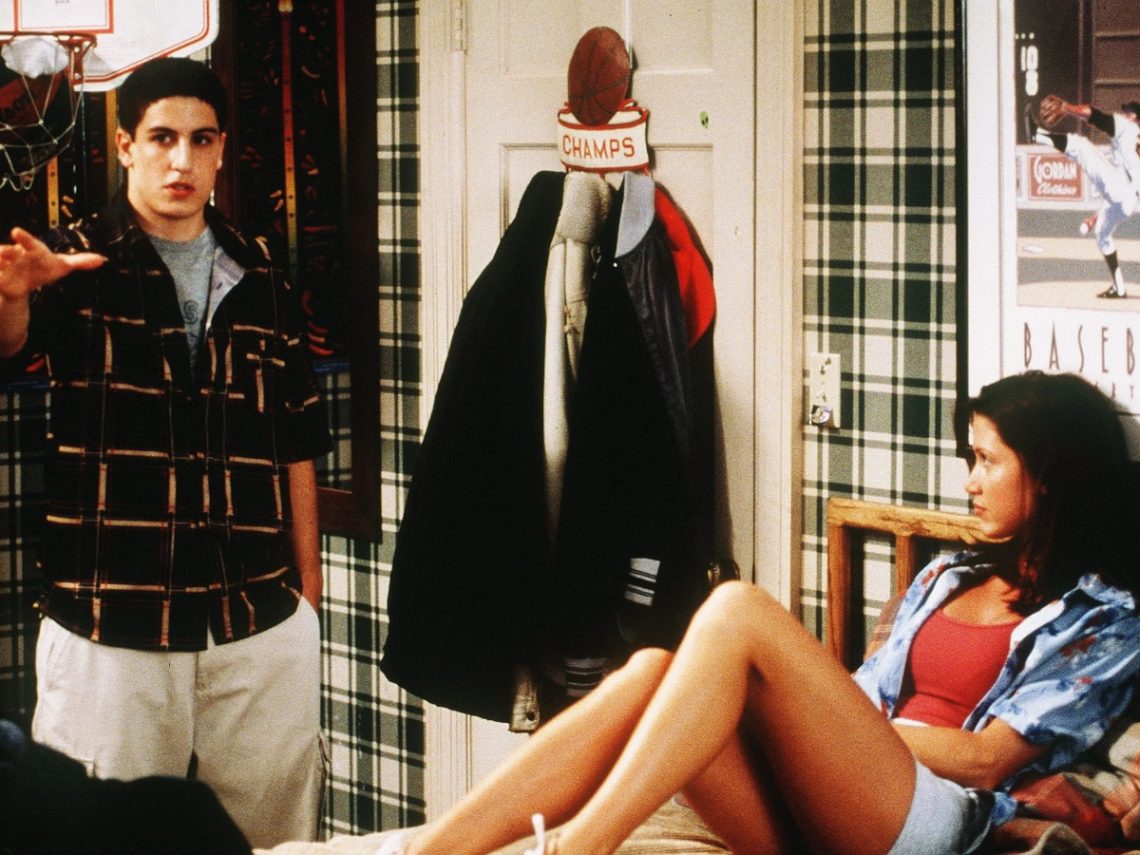
American Pie (Paul Weitz, 1999) – Livestream sex
We told you there’d be quite a few frat-boy comedies on this list. Though popular among teenagers across the world, Paul Weitz’s 1999 movie American Pie, which follows the story of four young men who enter a pact to lose their virginity by prom night, has dated quite a bit. There are several one-liners we could pick out as being ‘dated’, with several of these coming from the mouth of Stifler (Seann William Scott), but we’ve gone for one notorious moment.
The scene comes when Jim (Jason Biggs) agrees to set up a webcam to allow hundreds of fellow college students to watch him and Nadia (Shannon Elizabeth) have sex. Played for laughs; we’re not sure this scene would fly now.
Ace Ventura: Pet Detective (Tom Shadyac, 1994) – Transphobic comedy
Unfortunately, the kind of transphobic comedy that’s present in Ace Ventura: Pet Detective is also rife among other similar 1990s movies, with such moments coming from a time which was far less tolerant of the LGBTQ+ community. In this Jim Carrey comedy from 1994, the celebrated actor plays an eccentric pet detective who goes on a wild goose chase to find the missing mascot of the Miami Dolphins.
All in all, to cut a long story short, the big bad guy turns out to be a trans woman, with Carrey’s detective revealing this to a crowd of people in a rather demeaning manner. What makes matters worse is that people treat the woman with disgust throughout the movie.
Breakfast at Tiffany’s (Blake Edwards, 1961) – Mr. Yunioshi
It’s debatable whether Blake Edward’s 1961 movie Breakfast at Tiffany’s is even considered a classic anymore, with the movie merely being best known for the image of Audrey Hepburn seductively lying down whilst smoking from her elegant cigarette holder. This is largely due to the fact that Mickey Rooney’s supporting performance as Mr. Yunioshi is so grossly offensive it’s genuinely hard to take the movie seriously.
Imitating an Asian landlord with the use of flagrant stereotyping, the production team gave Rooney a wig and buck teeth as part of the shocking performance, making the whole thing surely one of the most offensive performances of all time.
Dodgeball: A True Underdog Story (Rawson Marshall Thurber, 2004) – Lance Armstrong
Recognised as one of the most beloved Hollywood comedies of the early 2000s, Dodgeball, by director Rawson Marshall Thurber, stars the likes of Ben Stiller, Vince Vaughn, Christine Taylor, Justin Long and Jason Bateman in a film that satires underdog sports movies. Whilst much of the film still holds up, there is one scene that has aged laughably badly which involves Vaughn’s Peter La Fleur and none other than the disgraced cyclist Lance Armstrong.
“I’m sure this decision won’t haunt you forever,” he tells the main character in a short speech that discusses “regret” and more. Gob-smackingly ironic, it’s likely that the cyclist regrets taking part in the doping scandal that saw him being stripped of his seven consecutive Tour de France titles.
Ghostbusters (Ivan Reitman, 1984) – Predatory behaviour
A staple of ‘80s American cinema, Ghostbusters tells the story of a group of parapsychologists living in New York City who venture out into professional ghost hunting to make ends meet. The leader of the group is Hollywood golden boy Bill Murray, a seemingly innocent and trustworthy presence in the industry with a clean slate, despite some questionable roles.
Murray’s character in this movie proves to fit this description. Peter Venkman reads to contemporary critics and audience members as a sexual predator, evident in his persistent approach towards women even when he is told no. Furthermore, Venkman informs his friends that he drugged a woman called Dana with Thorazine, a date rape drug. Despite the character actually being possessed, it’s still disturbing to hear this event played out in a comedy.
Venkman’s creepy behaviour as a whole is just outdated and immoral, especially given the recent MeToo movement.
Peter Pan (Hamilton Luske, Wilfred Jackson, Clyde Geronimi, 1953) – Native American scene
Based on J.M Barrie’s play of the same name, this Disney animated classic tells the magical story of the boy who never grows up as he whisks three children off to Neverland. There they meet mermaids, live with the lost boys and fight pirates, among other wild adventures.
As expected with visual material of the 1950s, some of Peter Pan’s handling of subject matter and representation reads as controversial and offence in this day and age. Neverland is home to a Native American tribe who are presented with racist imagery such as ‘red faces’. The sequence features an inappropriate song called ‘What Made the Red Man Red?’, attributing the Native American’s skin colour to blushing after a kiss. Disney+ has placed a warning before the film on their streaming service, acknowledging the issues with this depiction whilst criticising it in a modern setting.
Revenge of the Nerds (Jeff Kanew, 1984) – ‘Panty Raid’
This all-around American comedy stars Robert Carradine, Anthony Edwards, Ted McGinley, and Bernie Casey as a gang of nerds in a social battle against a team of jocks. The nerds set up their own fraternity to rival the athletes and teach them a lesson, giving the unseen outcasts a chance to shine in the process.
One outdated and objectifying scene from Revenge of the Nerds showcases a serious case of the male gaze as a child nerd “converses” with two full-figured women. The child shows no shame in speaking directly to the women’s chest, smirking as he averts his gaze between the two. It’s an unfunny attempt at frat guy humour that attempts to convince audiences that sexualising women is hilarious. It’s also unsettling to have a younger male exert such troubling behaviour.
Unfortunately, this is simply one of many shocking scenes in a movie that has aged terribly since the 1980s.
Rocky (John G. Avildsen, 1976) – Rocky and Adrian
In possibly one of the most definitive and beloved contributions to the sports drama, Sylvester Stallone takes a break from all the action hero roles to perform a more grounded and sentimental one as Rocky Balboa. This American classic charts the humble beginnings and rise of a passionate and talented boxer who dreams of becoming the world heavyweight champion.
After Rocky finds a potential love interest in pet shop worker Adrian, he invites her into his apartment one night. Despite an initial ‘no’ as a response, Rocky keeps pushing for her to come in, and when she eventually does, then he displays some forward and suggestive behaviour. When Adrian backs away and heads for the door, Rocky begs her to stay, and even places himself between her and the door. What was deemed romantic and ideal to a ‘70s audience now feels invasive, inappropriate and borderline sexual harassment to a contemporary one.
Scream 3 (Wes Craven, 2000) – Unfortunate true story
The third instalment of Wes Craven’s iconic meta-horror series uncovers the dark horrors of Hollywood, as a horror film set becomes infiltrated with real-life murders carried out by a copycat masked killer. This is placed against a backdrop of the systematic abuse that takes place in movie studio offices against young aspiring female actors.
Whilst it’s possible that Craven was issuing a warning against those vulnerable to the immoral antics that Hollywood tries so hard to cover up, there are holes in the execution, such as a hint of victim blaming and a sudden gloss over once the killer’s identity is revealed. Furthermore, this allegory reads as hypocritical and shallow once the information that the movie was produced by Harvey Weinstein, who echos the secondary antagonist, a rich movie producer who was also a rapist, comes to light.
Sixteen Candles (John Hughes, 1984) – Long Duk Dong
For the final film on our list, we’re returning to high school, a place that is far too often the breeding ground of unacceptable and hastily outdated values. Though he is seen as the ‘godfather’ of the coming-of-age movie, the films of John Hughes have actually dated very badly, with Long Duk Dong in Sixteen Candles being particularly troublesome alongside 1985’s The Breakfast Club and Weird Science.
A gross stereotype of Asian men, the character, played by the Japanese American actor Gedde Watanabe, was insultingly foolish and based on several offensive stereotypes.
