


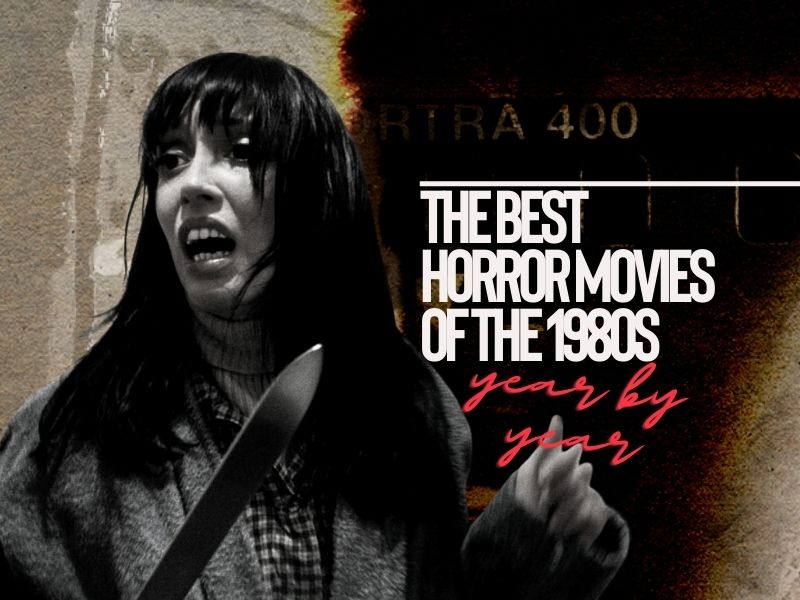
The 10 best horror movies of the 1980s year by year

The 1980s are initially chosen when people think of iconic or just horror movies. This decade is beloved and worshipped by the horror community thanks to its creativity in stories, style, and distinct image.
While the ’60s and the ’70s were characterised by suspense and keeping things in the dark to build tension, the ’80s chose to throw everything out there. Horror films from this time are recognised for buckets of gore, over eccentric villains and just overall cheese factor.
These elements have progression in practical and visual effects to thank. Prosthetics could allow the skin to be distorted and limbs to be ripped off. This decade also offered bright signature colours of red and black that painted the screens with a mighty boldness. Some of the greatest horror masters put their artistry to full effect and earned their titles.
The ’80s gave us countless horror films to enjoy; some of the genre’s most famous faces were born during this decade. Choosing just one superior from each year cannot be done so quickly.
Check out the full list below.
The 10 best horror movies of the 1980s year by year:
1980 – The Shining (Stanley Kubrick)
The adaptation of Stephen King’s successful horror novel follows author Jack Torrance who accepts a caretaker job at the Overlook Hotel. He takes his devoted wife Wendy and their ‘gifted’ son Danny to live isolated from the rest of the world for the winter. But they’re not alone in the hotel, as a ready evil lurks in every room.
The Shining can be viewed in three ways – as a King fan, a Kubrick fan, or a horror fan. While the first two may compromise the ability to praise the film, the final one derives nothing but acclaim. It is one of the greatest horror films made due to its brilliant direction and performances. It’s a snowball of tension and fear, with this unshakeable feeling of dreadful eeriness in every shot of the hotel.
1981 – Possession (Andrzej Zulawski)
A man who cannot seem to understand his wife’s reasons for leaving him starts to follow her. At first, he suspects that there is someone else. However, he finds out more and more strange behaviours and bizarre incidents that make him wish his initial suspicion was right.
Zulawski successfully balances the 70s emphasis on tension with the flashy visual scares from this new era. The story builds up consistent questions about what is going on and why, and then some insane gore is thrown in out of nowhere.
1982 – The Thing (John Carpenter)
A group of researchers in Antarctica discover a strange entity out in the snow and bring it inside for inspection. However, by doing so, they allow an alien parasite to work its way through the group by assimilating its DNA.
The Thing delivers some of horror’s most infamous and recognised body horror. The body distortions are out of this world, as Carpenter drew inspiration for the designs under the advice of “if you can show something scarier than the devil itself, you’ve made a good horror”. There’s still plenty of well-executed suspense to balance out the visuals with the atmosphere.
1983 – Videodrome (David Cronenberg)
Master of Body Horror David Cronenberg tells the story of a TV station CEO who stumbles upon a snuff porn collection, triggering an exploration into a mind control facility. As he digs deeper, he loses touch with reality in a series of increasingly bizarre hallucinations.
Videodrome shows a lot of Cronenberg’s artistic strengths and is definitely a unique experience. It provides some outlandish gore alongside some subtextual context of humanity vs technology, as the flesh is blended with machinery. Its themes and visuals also showed the sci-fi genre in some new and original light.
1984 – Nightmare on Elm Street (Wes Craven)
Another Master of Horror contributed some creative heights to the genre with this story. A supernatural villain, Freddy haunts teens in their dreams. After discovering his sinister origin, some of them derive a plan to trap and take him down.
Craven’s concept of a killer who attacks you where you can’t be protected and where you can’t avoid is an untouchable one. Freddy Krueger is one of horror’s most iconic figures, whose attacks on teenagers have been interpreted as symbolic of traumatic adolescence.
1985 – Day of the Dead (George A. Romero)
A small team of scientists, civilians and trigger-happy soldiers battle desperately to ensure the survival of the human race. However, the threat of a flesh-eating zombie army waiting outside causes conflict and tension.
Horror master director Romero explained the film as “a tragedy about how a lack of human communication causes chaos and collapse even in this small little pie slice of society”. This thematic concept is executed with some stomach-churning gore and original takes on zombies.
1986 – Aliens (James Cameron)
When communications are lost with a human colony on the moon on which her crew first encountered the alien creatures, Ripley agrees to return to the site with a unit of Colonial Marines to investigate.
Aliens receives numerous titles, such as one of the greatest sci-fi films, one of the greatest 80s films and one of the greatest sequels. The attention to detail in the visual effects and camera style pays off as the film executes some terrific suspense and jump scares.
1987 – Evil Dead II (Sam Raimi)
Ash Williams heads to a remote cabin with his girlfriend and discovers an audio tape of recitations from a book of ancient texts. He makes the mistake of playing it, and a number of tormenting demons are released.
As this sequel was given a bigger budget following the success of the first, Raimi went to a whole new level. Evil Dead II offers some timeless entertainment alongside its scares because it’s as insane as it is creepy. Its material is built from madness and stands out from other releases of the time.
1988 – Spoorloos/The Vanishing (George Sluizer)
A couple, Rex and Saskia, are enjoying a biking holiday in France. When they take a pit stop at a gas station, Saskia disappears, and Rex becomes frantic in his search.
The Vanishing received international praise at the time of its release. Due to its original execution and absence of cliches, The Washington Post deemed it “refreshingly free of manipulative scenes involving running bath water, jagged-edge cutlery and bunnies in the saucepan”. Kubrick called it one of the scariest films he had ever seen, thanks to its unfamiliar structure that eliminates all safety.
1989 – Santa Sangre/Holy Blood (Alejandro Jodorowsky)
A young circus performer called Fenix struggles with childhood trauma as he spends his days in an institution ward. He eventually escapes and tries to find his estranged mother.
Jodorowsky creates a word of emotional art with a psychological kick. It communicates fear under some surreal poetic imagery and an avant-garde palette. Gore is used for artistic purposes as well as a shocking scare factor, and reality is depicted as a nightmare. Its techniques are designed to tax your mind and so so unapologetically.
