


The 10 best disaster movies of all time

The bare minimum expected of a disaster movie is at least one eye-catching action sequence, if not several more beyond, but the very best examples of the genre have plenty of steaks to go along with their sizzle.
The era of CGI being used as the default option to display devastation has undeniably led to a rise in how lavish the disaster epic can be when it comes to realising citywide or even planetary destruction, but no amount of visual polish or technical sheen can compensate for a shoddy story and unmemorable one-note characters.
That’s not to say the finest features to ever emerge from cinema’s obsession with the cataclysmic are universally acclaimed and lauded for telling intimate, moving tales expertly performed against the backdrop of untold devastation, but there’s definitely a balance to be struck.
The following ten titles all hit that sweet spot with aplomb, sending each of them down in the history books as being among the greatest disaster thrillers ever made.
The 10 greatest disaster movies:
10. Armageddon (Michael Bay, 1998)
As spectacular as it is stupid, Nasa has ironically embraced Michael Bay‘s Armageddon to the extent it uses the countless inaccuracies present in the film during its management training programme, with the director laughing in the face of science to focus solely on scope, scale and spectacle.
Ben Affleck might be a bit of a wet blanket in the central role, but his flimsy performance is easily overshadowed by Bruce Willis at his grizzled best, while the real casting masterstroke came by filling out the ensemble with character actors like Steve Buscemi, Owen Wilson, Michael Clarke Duncan, Jason Isaacs, Billy Bob Thornton, Peter Stormare, and the rest, all of whom bring plenty of personality to one-dimensional parts.
Throw in stunning visual effects, Bay’s favoured practical carnage, delightfully stupid story developments (with a special mention for space dementia), and a dizzying sense of nothing being truly off the table in terms of just how dumb things are going to get, and Armageddon rightfully delighted crowds the world over.
9. The Wave (Roar Uthaug, 2015)
The disaster epic is a market that’s largely been cornered by Hollywood since the very beginning, but The Wave didn’t just show that Scandinavia was capable of playing Tinseltown at its own came, but it was more than capable of doing it better.
Not only that, but Roar Uthaug’s Norwegian blockbuster would even launch a franchise, with The Quake and The Burning Sea equally impressive in blending character-driven drama with splashy set pieces on a budget that’s only a fraction of what the genre has been associated with for decades.
Kristoffer Joner’s geologist Kristian Eikjord desperately tries to scurry his family to safety when a 250-foot tidal wave threatens to wipe out everything in its path, but the formulaic setup derivative of countless other disaster dramas before it is easily offset with stellar visuals, excellent performances, and a sense of genuine tension that’s increasingly difficult to manufacture in this particular cinematic arena.
8. The Day the Earth Caught Fire (Val Guest, 1961)
A black-and-white British movie telling a ground-level story, The Day the Earth Caught Fire opts for a much more realistic approach to disaster than the majority of its bedfellows, which is part of the reason why it’s endured as one of the best ever made.
Edward Judd’s reporter and Leo McKern’s journalist discover that American and Russian nuclear explosions detonating at the exact same time have thrown the planet from its axis, causing fires and earthquakes to ravage humanity as society plunges into chaos at the prospect of its impending doom.
The onus is placed on the people above all else, with director Val Guest preying on the very real fears that were prevalent at the time and still are today – including global warming, nuclear armament, and dwindling natural resources – to craft a rich and compelling character piece that doubles as a social parable, all drenched in the eerie atmosphere of the incoming apocalypse.
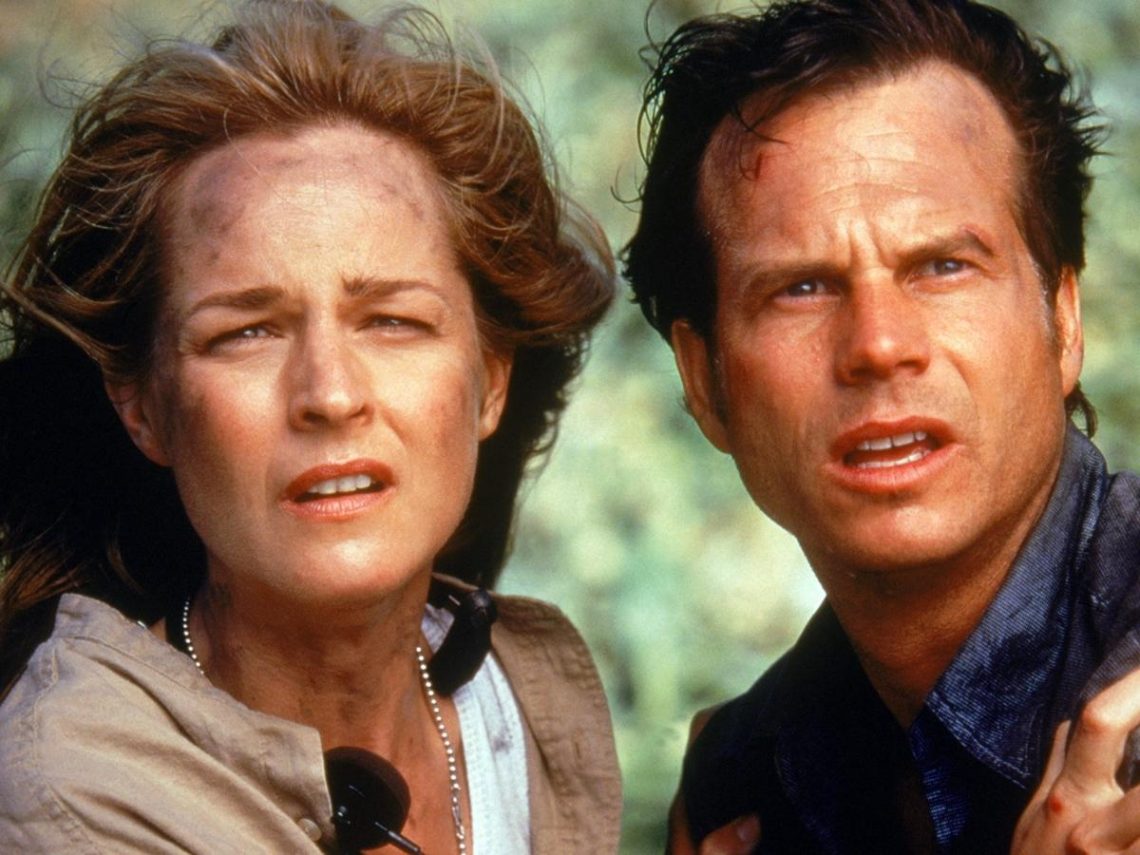
7. Twister (Jan De Bont, 1996)
Arriving in the aftermath of Terminator 2: Judgement Day and Jurassic Park ushering in the CGI revolution, Twister weaponised the rapid advances in digital effects to deliver a fast-paced and frantic blockbuster that put its foot on the gas from minute one and refused to let up.
Director Jan De Bont’s previous feature was the all-time action classic Speed, and his proven ability to helm high-concept crowd-pleasers almost entirely reliant on practical effects allowed him to paint on a bigger canvas than ever before now that CGI was an option on the table to realise the sort of wanton destruction that had always been out of the disaster thriller’s reach.
The fantastic cast compensates for a relentlessly by-the-numbers storyline, underlining that gathering together a string of talented performers – which in this case numbered Bill Paxton, Helen Hunt, Cary Elwes, Phillip Seymour Hoffman, Alan Ruck, and Jeremy Davies – before dropping them into a ludicrous situation can exponentially increase the entertainment value, although Twister is hardly lacking in that department either through a nonstop barrage of blustery bravado.
6. Concrete Utopia (Um Tae-hwa, 2023)
Submitted as South Korea’s entry for ‘Best International Feature Film’ at the 2024 Academy Awards, Concrete Utopia may not have made the final shortlist, but even being considered offers a metric of its value as not just a disaster movie, but a work of cinema.
After a massive earthquake reduces Seoul to ruins, only one apartment building in the entire city is left standing, which by default becomes the centre of civilisation among the survivors. As more and more people descend upon Imperial Palace Apartments, the existing residents grow increasingly suspicious as the new arrivals become more desperate, building tensions to boiling point.
Anchored by an incredible performance from Lee Byung-hun, the allegories are ladled on thick and fast as bad blood simmers between the haves and have-nots of Concrete Utopia‘s post-apocalyptic future, but the atmosphere is masterfully built amidst the character-driven drama and visceral thrills to create a staggering look at the end of the world.
5. The Towering Inferno (John Guillermin, 1974)
The figurative dick-measuring between Steve McQueen and Paul Newman gathered plenty of headlines, resulting in their names being arranged diagonally in the marketing so that neither A-lister established dominance, but it’s a testament to The Towering Inferno that it would have been just fine without them.
Of course, it helps immeasurably having two of Hollywood’s biggest-ever icons sharing the screen to enhance the grandiosity on display, but The Towering Inferno doesn’t rest upon the insecure shoulders of its main draws, neither of whom could sanction the thought of taking second billing.
Instead, the three-time Academy Award winner thrives on its overindulgence. Beyond McQueen and Newman, the budget was massive, the running time was exorbitant, and the sets were monumental, enshrining The Towering Inferno as a super-sized spectacle that holds up a lot better than The Glass Tower could ever dream of.
4. The Impossible (J. A. Bayona, 2012)
When production started on The Impossible, there were some not entirely unreasonable criticisms of a movie recreating a real-life disaster that claimed over 220,000 lives stepping in front of cameras less than five and a half years after the Indian Ocean earthquake and tsunami, but the film assuaged many of those doubts and concerns.
Even if it only secured a solitary Academy Award nomination for Naomi Watts in the ‘Best Actress’ category, the dramatization of the harrowing sequence of events was widely praised for the way in which it handled its narrative with accuracy, care, respect, and grace.
Made all the more compelling – and haunting, for that matter – by the tsunami being so fresh in the memory, the emotionally charged performances and focus on a single family narrowed the scope while increasing the stakes, with the tsunami sequence itself equal parts distressing in its authenticity and staggering in its visual merits.
3. The Poseidon Adventure (Ronald Neame, 1972)
Blockbusters didn’t often find themselves competing for major Academy Awards in the early 1970s, but The Poseidon Adventure was so impressive on every level that the nine-time nominee couldn’t be overlooked, earning a ‘Special Achievement Award’ for ‘Best Visual Effects’ in one of its two wins.
The decade’s disaster movie craze was already in full swing by the time Ronald Neame’s aquatic tragedy was released in 1972, but a combination of a top-tier cast firing on all cylinders and impeccable effects took it to brand new heights, or depths to be more literal.
Genuine peril is a hard thing for the genre to achieve when the screen is littered with star names and the marquee set pieces often take precedence, but The Poseidon Adventure never sacrifices story at the altar of spectacle, resulting in an undoubted technical marvel that hardly skimps on tugging at the heart-strings.
2. Titanic (James Cameron, 1997)
James Cameron‘s labour of love was being set up to fall by those who predicted the single most expensive movie in the history of cinema was doomed to disappoint, only for the filmmaker to end up laughing all the way to the bank… and then onto the Academy Awards.
The highest-grossing film of all time and the winner of a record-tying 11 Oscars, Cameron bolting a fictional romance onto one of history’s most notable disasters turned an epic love story into a cultural phenomenon that drummed up repeat business to an extent rarely seen before, or since.
Ironically, the overwrought melodrama is the weakest part of Titanic by far having come directly from Cameron’s own mind, but the performances of the cast and trail-blazing work from the crew cemented it as an epic in every sense of the word, one that demanded to be seen on the big screen at least once.
1. Airplane! (Jim Abrahams, Jerry Zucker, and David Zucker, 1980)
One of the finest comedies ever made, Airplane! might be a spoof and a parody, but it was designed, constructed, and shot with the utmost seriousness and attention to detail, never mind a plot that finds a plane struck with disaster in mid-air when the crew are incapacitated.
Lifting the bare bones of its narrative, several characters, the exclamation mark, and even lines of dialogue verbatim from 1957’s Zero Hour!, Airplane! was also indebted to the four-film Airport franchise, grounding it firmly in the realms of serious drama.
That applied to the cast, too, with the filmmakers intentionally hiring dramatic veterans, including Leslie Nielsen, Peter Graves, Lloyd Bridges, and Robert Stack, instructing them to recite their dialogue and pitch their performances with the utmost seriousness to lend distinguished gravitas to the inherently ridiculous.
Most of the comedy intentionally comes from things being played completely straight, with Airplane! poking fun at the entire disaster genre and its habit for portentous solemnity being the driving force behind stories that aren’t rooted in any semblance of grounded reality, which played no small part in cementing it as a classic.
