


Hear Me Out: The New Eves’ debut album will become a landmark in modern folk

For as long as we remain on planet Earth, folk music is destined to survive.
As long as there is a world around us and a culture within which we live, folk music has the power and longevity to outlive disasters. In fact, it’s likely to grow stronger in the aftermath of tragedy, spurred on by the grief and confusion arising as a result of it. However, if there is one thing that is crucial to its survival that only its creators can be in control of, it’s the necessity of its evolution.
Folk music is so rooted in the society that exists around it that it’s only natural that it begins to adapt to the times, and seeing as obsessions with new technologies have come around, so have strands of folk music that incorporate them. Our tastes are shaped by algorithms, so people aren’t as sworn to remaining part of one genre or scene today. Hence, it makes complete sense that in these times, we’ve witnessed folk turn into an amorphous and malleable genre that can easily accommodate influence from other genres that are just as rooted in our own self-created culture.
I’m not saying that if Ewan MacColl were still alive, he’d now be flirting with folk trap, and as much as I’d be intrigued to hear a Shirley Collins hyperfolk record now she’s entered her 90s, I suspect it’s not going to arrive without the help of the dreaded artificial intelligence. However, what artists like these focused on is the state of the world around them, and with the world currently dipped in perpetual anxiety, bemused by its weirdness and expectant of a looming end times, it makes sense that our folk music does the same.
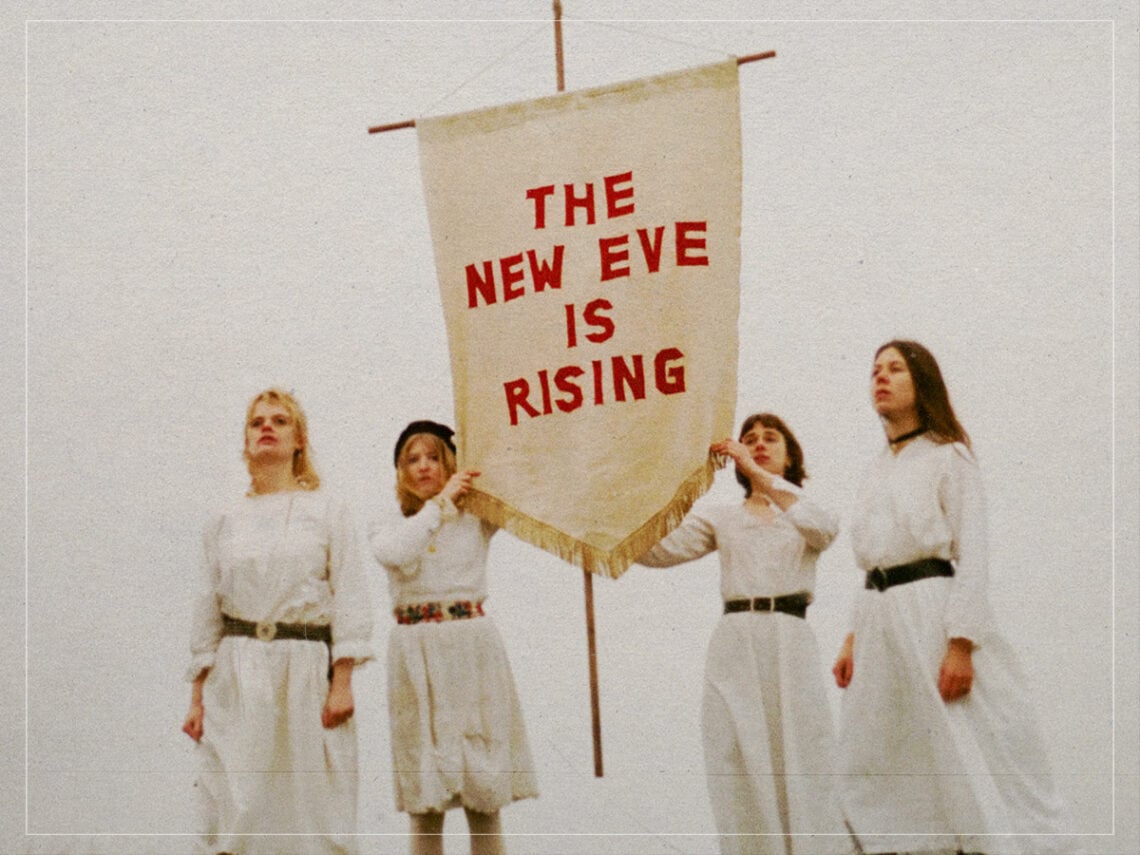
While it doesn’t necessarily adhere to all of the above in the most obvious ways, The New Eves’ recently released debut album, The New Eve is Rising, is perhaps one of the most pertinent developments in folk music to happen in recent years, and is the sort of album that is likely to be regarded as a pivotal moment in the merger of folk and contemporary indie music in years to come.
The Brighton-based foursome consists of a typically folky ensemble, made up of guitarist and cellist Nina Winder-Lind, guitarist and violinist Violet Farrer, drummer and flautist Ella Russell, and bassist Kate Mager, with all four members providing vocals at some point on the record, either to produce luxurious harmonies or to wail cathartically. Sounds like folk, yes?
However, the bands that The New Eves get compared to most frequently tend to fit more squarely in the punk and post-punk brackets. There are shades of The Velvet Underground, particularly their work with Nico, in the way the vocals are delivered and how Russell takes the Maureen Tucker approach of standing behind the kit to create a more tribal feel. There are elements of The Raincoats in how ramshackle and raw it can be at times, never too focused on tightness as a unit, but more on conveying a moment. There’s an artsy obtuseness to what The New Eves are doing that isn’t exactly reminiscent of folk music, yet at its core, it completely fits the brief.
The weirdness, the anxiety and the apocalyptic feelings mentioned prior are the three standout elements of what makes The New Eve is Rising a special album, and they’re all delivered in abundance across the record. The fact that the band are playing largely with themes of creationism, rebirth and Pagan tradition in a modernist environment is what makes it such a peculiar oddity in a future-obsessed landscape. The building of tension through agitated strings, primal drumming and slightly off-key howls gives off a nervousness until they culminate in a cataclysmic wall of sound that feels like the world coming to an end.
From the titular opener, ‘The New Eve’, where Winder-Lind delivers a manifesto for the band’s mere existence, captures the spirit of the group, all the way through to closing track ‘Volcano’, which aptly feels as though it’s about to erupt at any point, the band keeps the listener on tenterhooks, always anticipating a dramatic change of pace. ‘Cow Song’ and ‘Circles’ are standouts for how well they meld folk tradition with avant-garde and punkish sensibilities, while early single ‘Astrolabe’ has a ritualistic feel to it underneath its repetitive drones and chanted choruses.
There are no other bands delivering folk music that sounds so delightfully different or rooted in a love of other genres, and while there are plenty of other acts that feel primarily rooted in punk or jazz with a folk tinge to their work, The New Eves reverse this by offering a countering statement.
The New Eve is Rising is the sort of album that is going to capture the essence of folk music from this period in years to come, and, for better or worse, they’ve provided an exemplary study on what it’s like to be living in this period through the medium of folk.
